

The final constitutional hours were accelerating inside the corridors of Iraq’s ruling Shiite Coordination Framework, while the pace of bilateral and group meetings intensified in parallel. Meanwhile, speculation about the identity of Iraq’s next prime minister circulated across media outlets and social media, with no consensus emerging.
The country has been run by a caretaker government for nearly five months, following general elections held in November 2025.
The constitutional countdown began after parliament voted on April 11 to elect Nizar Amedi as president of the republic. Under the constitution, the largest parliamentary bloc has 15 days to nominate a candidate for prime minister after the presidency is filled.
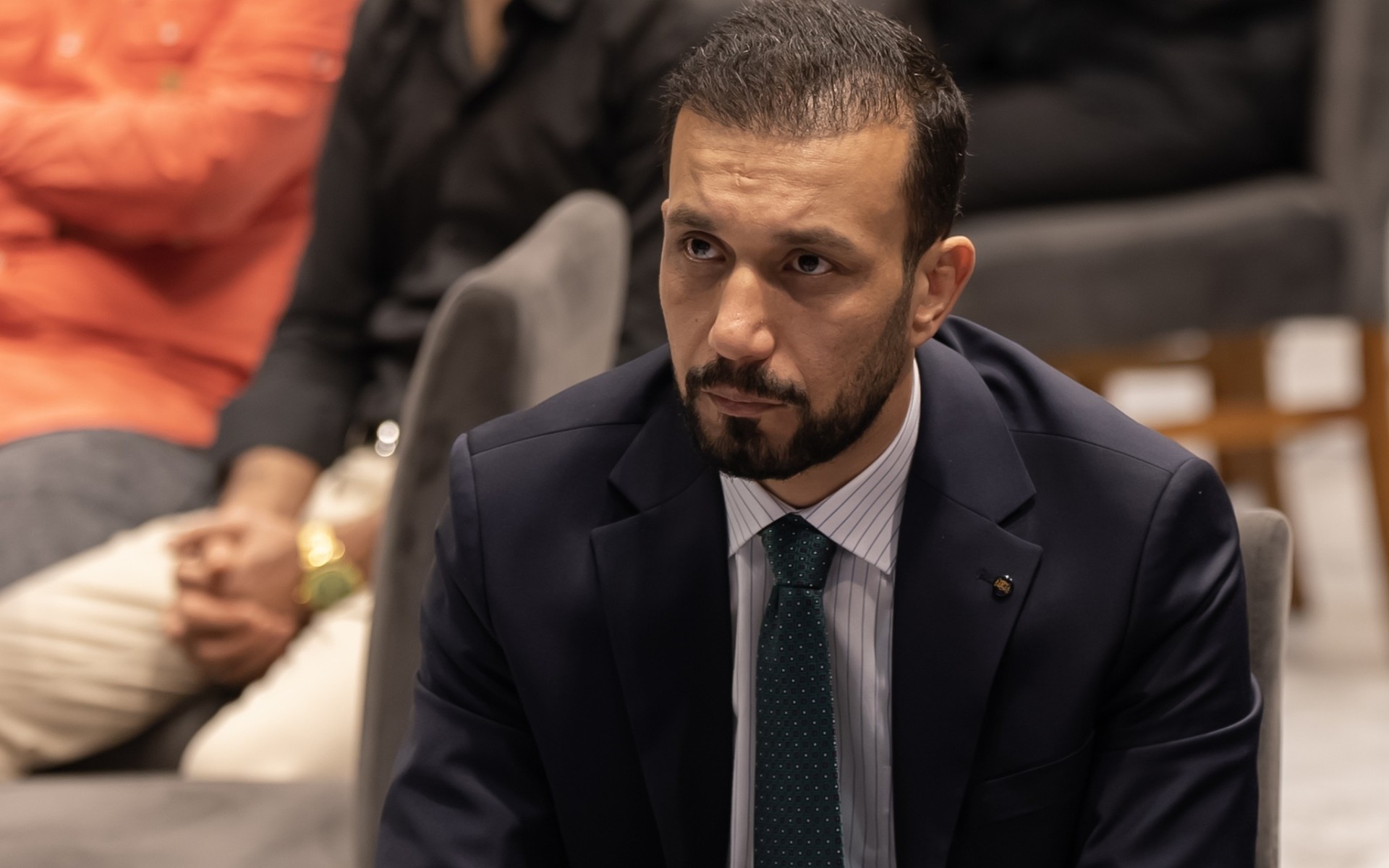
Just hours before the constitutional deadline expired, the name of Ali al-Zaydi emerged as the Coordination Framework’s candidate for prime minister.
U.S. President Donald Trump congratulated al-Zaydi on Thursday on his nomination, saying in a post on Truth Social that he looked forward to a “strong, vibrant, and highly productive new relationship between Iraq and the United States.”
Al-Zaydi is not a traditional politician. A businessman with no political background or experience in state institutions, he nonetheless appeared to the Coordination Framework as a temporary solution to an internal and external crisis that has been escalating rapidly.
But the path to the premiership did not begin in Baghdad alone.
Two days before al-Zaydi was nominated, a sharply worded U.S. message was delivered to senior Coordination Framework leaders by U.S. Chargé d’ Affaires in Baghdad Harris Joshua. The message, which was also sent to Western missions, was described as more than a diplomatic objection, and closer to an open political and security warning.
Alhurra obtained a copy of the U.S. message from a Coordination Framework leader.
The U.S. State Department did not respond to a request for comment sent by Alhurra via email. However, an Iraqi government source told Alhurra that the circulated message was addressed to the Coordination Framework and not the government, adding that while it is authentic, it was not formally received by the government but rather by Framework leaders.
The message followed an internal Framework meeting attended by Abu Ala al-Walaei, along with figures linked to Iran-backed armed factions, some of which are designated by the United States as terrorist organizations. For Washington, al-Walaei’s presence reflected what it described as “alignment” between the Iraqi state and armed groups.
On April 24, the United States announced a reward of up to $10 million for information leading to the identification or location of Abu Ala al-Walaei (Hashim Finyan al-Saraji), secretary-general of Kataib Sayyid al-Shuhada, which the United States designated a terrorist organization in 2023.
The move followed his designation as a “global terrorist” in 2023. The U.S. State Department accuses him of orchestrating rocket and drone attacks against U.S. interests in Iraq and Syria, and of being a key ally of Iran’s Islamic Revolutionary Guard Corps in the region.
At that moment, Washington viewed the selection of a prime minister inside a room that includes individuals listed as terrorists or internationally wanted figures as a development that could place the legitimacy of the next government in question before the international community.
Iraqi sources within the Coordination Framework and others in the government of Mohammed Shia al-Sudani told Alhurra that the U.S. message used unprecedented language in addressing Baghdad. It explicitly referred to a “fundamental flaw” in the Framework’s understanding of shifts in U.S. policy toward Iraq, particularly amid escalating attacks on U.S. interests and regional partners.
Washington not only held armed factions responsible for the attacks but also referred to “state sponsorship and financing of terrorism,” in reference to the continued political cover these groups receive within state institutions.
From Washington’s perspective, official statements condemning armed attacks were no longer credible as long as faction leaders sit at political negotiating tables and participate in shaping the next government, according to the message.
For this reason, al-Zaydi’s nomination came amid calculations far more complex than simply forming a new government.
While he received congratulations from several capitals, including Washington, the U.S. message behind the scenes conveyed something very different: that Iraq’s relationship with the United States had entered a phase of “either partner or adversary.”
The message also directly referenced President Donald Trump, signaling that Washington was prepared to return to a policy of “direct response,” an approach based on targeting those carrying out attacks, as well as those providing political, financial, or administrative cover.
This shift unsettled the Coordination Framework itself.
A senior leader in the ruling alliance described the message as a “final warning,” saying the United States clearly signaled options beyond traditional sanctions, including potential military action against armed factions if the Iraqi government continues to fail to dismantle or contain them.
But the problem for the Framework is not that simple. Armed factions are not merely separate groups outside the political system; they are part of Iraq’s internal balance of power and are linked to extensive political, economic, and security networks, as well as close ties to Iran.
As a result, al-Zaydi found himself from the outset facing an almost impossible equation: how to convince Washington he can protect U.S. interests and control uncontrolled weapons without clashing with the very forces that brought him to power.
Kawa Hassan said the U.S. message represents a dramatic shift in Washington’s approach to Iraq.
Hassan told Alhurra that the message can be summed up in one sentence: “Either you dismantle the armed factions, or we will do it ourselves.”
This tone reflects a U.S. conviction that Iraq is part of the broader regional conflict linked to Iran, rather than a purely domestic arena. Therefore, any new government will be judged not only on its ability to manage services or the economy, but on its willingness to redefine the relationship between the state and weapons.
While al-Zaydi was receiving congratulations on his nomination, the U.S. message was setting the real test for his potential premiership, raising several questions, most notably: Can he be a prime minister for Iraq, or merely a new face for old power balances now in direct confrontation with Washington?
Haider al-Shakeri said al-Zaydi’s rise to the premiership came as a “compromise candidate” imposed by U.S. pressure and the complexities of U.S.-Iran relations.
Al-Shakeri said al-Zaydi will not have wide room for independent decision-making, as sensitive portfolios will remain subject to Coordination Framework consensus, including issues related to the Popular Mobilization Forces and armed factions.
According to the Chatham House researcher, any new prime minister will effectively be bound by the political understandings that brought him to power, meaning he will implement the Coordination Framework’s collective agenda rather than act independently.
Al-Zaydi will face a difficult equation that cannot be navigated from the middle. The weapons of Iran-aligned factions must be ended according to U.S. messages, while Iran seeks to expand or at least preserve its network of allies in Iraq. Between the American and Iranian agendas, al-Zaydi—if he secures parliamentary approval—will be in a position fundamentally different from that of his predecessor.
The article is a translation of the original Arabic.

Mustafa Saadoon
Mustafa Saadoon is an Iraqi journalist who has worked for several international and Arab media organizations. He covers politics and human rights.
