
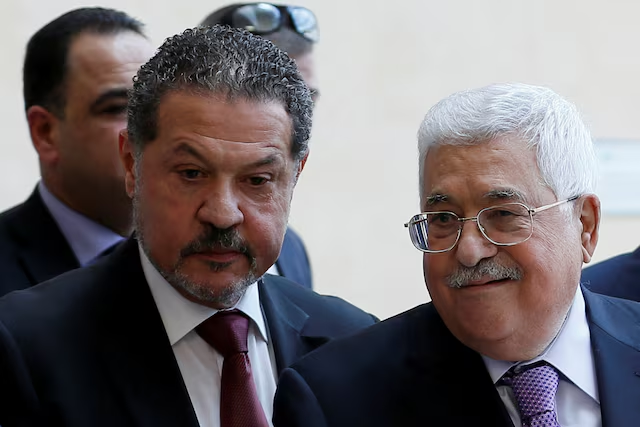


Mohsen Rezaei, one of the longest-serving figures in Iran’s Islamic Revolutionary Guard Corps, has returned to the heart of Tehran’s national security establishment, after Supreme Leader Mojtaba Khamenei appointed him secretary of the Supreme National Security Council.
The appointment puts the former Guards commander in a pivotal position at a particularly fraught moment for Iran’s leadership, as it confronts a war with the United States, a crisis in the Strait of Hormuz, negotiations and mounting pressure at home. Rezaei will now have a direct hand in shaping how Tehran navigates those overlapping crises.
The post gives Rezaei a direct role in overseeing defense, national security and foreign policy, alongside his position as a military adviser to the supreme leader and his membership in the three-member council that has governed the country since the death of the previous supreme leader.
But Rezaei’s ascent is about more than his long career in the Revolutionary Guards, according to Iranian opposition figures who spoke to MBN. They also link his return to the resurgence of Mansouroun (the Triumphant), a hardline militant group that operated against the shah’s government before the 1979 revolution. Rezaei, whose full name is Sabzevar Rezaei Mirgha’ed, was among its most prominent founders.
Mansouroun was among the groups that Ruhollah Khomeini relied on to build the Revolutionary Guards after the shah was overthrown.
Iranian opposition sources say figures associated with the group have regained influence in recent months across state institutions, the Revolutionary Guards and the security services, as the centers of power are reshuffled following Ali Khamenei’s death and the elevation of his son, Mojtaba, as supreme leader.
Among the figures the sources associate with the group are Gholam Ali Rashid, the commander of the Guards’ Khatam al-Anbiya Central Headquarters, who was killed in an Israeli strike during the 12-day war in June, and Ali Shamkhani, a former Guards and naval commander and former secretary of the Supreme National Security Council, who was killed in February in a joint U.S.-Israeli strike.
Rezaei, who has been under U.S. sanctions since 2019, is now one of the most influential figures in Iran’s leadership.
Article 176 of Iran’s Constitution tasks the Supreme National Security Council with setting defense and national security policies within the framework established by the supreme leader, coordinating political, military, intelligence and economic institutions, and mobilizing state resources to confront internal and external threats.
Rezaei’s appointment coincided with a series of changes at the top of the armed forces, the Revolutionary Guards and the Basij. The United States had for long designated the IRGC and the Basij as terrorist organizations. Ali Abdollahi was appointed chief of the General Staff of the Armed Forces, with Kioumars Heydari as his deputy. Ahmad Vahidi was confirmed as commander in chief of the Revolutionary Guards, with Mostafa Izadi as his deputy. Ali Azmaei was appointed commander of the Guards’ naval forces, while Hossein Taeb, the former head of Guards intelligence, was named head of the Basij Organization.
Samir Yassin, secretary-general of the Arab Front for the Liberation of Ahwaz, said the appointments amounted to more than a reshuffling of personnel, pointing instead to a broader reordering of centers of influence and decision-making mechanisms within the system.
He told MBN that Rezaei’s return to the center of national security decision-making places his “long military and security experience” in a sensitive position at a time when Iran faces military, political and economic pressure, as well as the Hormuz crisis and negotiations with the United States.
The next phase, he said, could bring tougher deterrence measures, greater room for negotiations, or a combination of both, depending on how the confrontation develops.
Rezaei is known in media circles close to the Revolutionary Guards as the “architect of the Guards,” a reference to his role in building the organization during its formative years.
Khomeini appointed him commander of the Revolutionary Guards in 1981, a post he held until his resignation in 1997. During that period, he led the Guards through most of the Iran-Iraq War, oversaw the development of its ground, air and naval forces, and played a role in establishing the organization’s intelligence apparatus and expanding its military capabilities.
His name has also been associated with the creation of the Quds Force and with the early development of Iran’s missile and nuclear programs.
Mehdi Reza, an expert on Iranian and Middle Eastern affairs, told MBN that Rezaei is not expected to “change the essence of the regime’s policy,” but rather to give the military and security establishment greater weight in managing sensitive issues.
The Supreme National Security Council, he said, is where questions involving the war, Hormuz, negotiations, internal security and the role of the Revolutionary Guards converge. Rezaei’s selection, he added, reflects the leadership’s desire for a figure capable of coordinating among the military establishment, the government, the security agencies and the supreme leader’s office.
Reza said Rezaei differs from many of the regime’s military commanders because he has combined leadership of the Revolutionary Guards with decades of political and institutional experience.
After leaving the Guards’ command, Rezaei held political and strategic posts and ran for president several times, giving him, according to Reza, experience in dealing both with the military establishment and with politics and internal bargaining.
Reza does not expect that experience to produce a more moderate policy. Instead, he sees Rezaei’s appointment as a sign of the leadership’s anxiety over a period in which external pressure is converging with the Hormuz crisis, divisions within the ruling establishment and fears of domestic unrest.
One of Rezaei’s tasks, he said, will be to bring those issues together within a more cohesive security framework while giving the Revolutionary Guards a larger role in determining Iran’s next moves.
Analysts who spoke to MBN said one of the main objectives behind Rezaei’s appointment was to strengthen Mojtaba Khamenei’s position within the system at a time when Iran’s centers of power are still adjusting to the leadership transition.
Political analyst Jafar Ziyara said Rezaei would be expected to help consolidate decision-making behind the new supreme leader, expand the Revolutionary Guards’ role in political and security affairs, and prepare the system to manage domestic and external challenges with greater reliance on the military establishment.
“The arrival of a man who knows war well at the institution that determines the relationship between war and diplomacy means the logic of war will have a greater presence in the council’s decisions, particularly amid the confrontation with the United States and Israel and the dispute over the Strait of Hormuz,” he said.
But Ziyara said Rezaei’s appointment did not necessarily signal a strategy of “war to the end.”
Instead, he said, Rezaei’s task may be closer to managing the confrontation in ways that improve Iran’s negotiating position: prolonging the crisis when useful, raising the costs for Iran’s adversaries and spreading pressure across multiple fronts, while keeping the door to negotiations open.
Adapted and translated from the original Arabic.


