
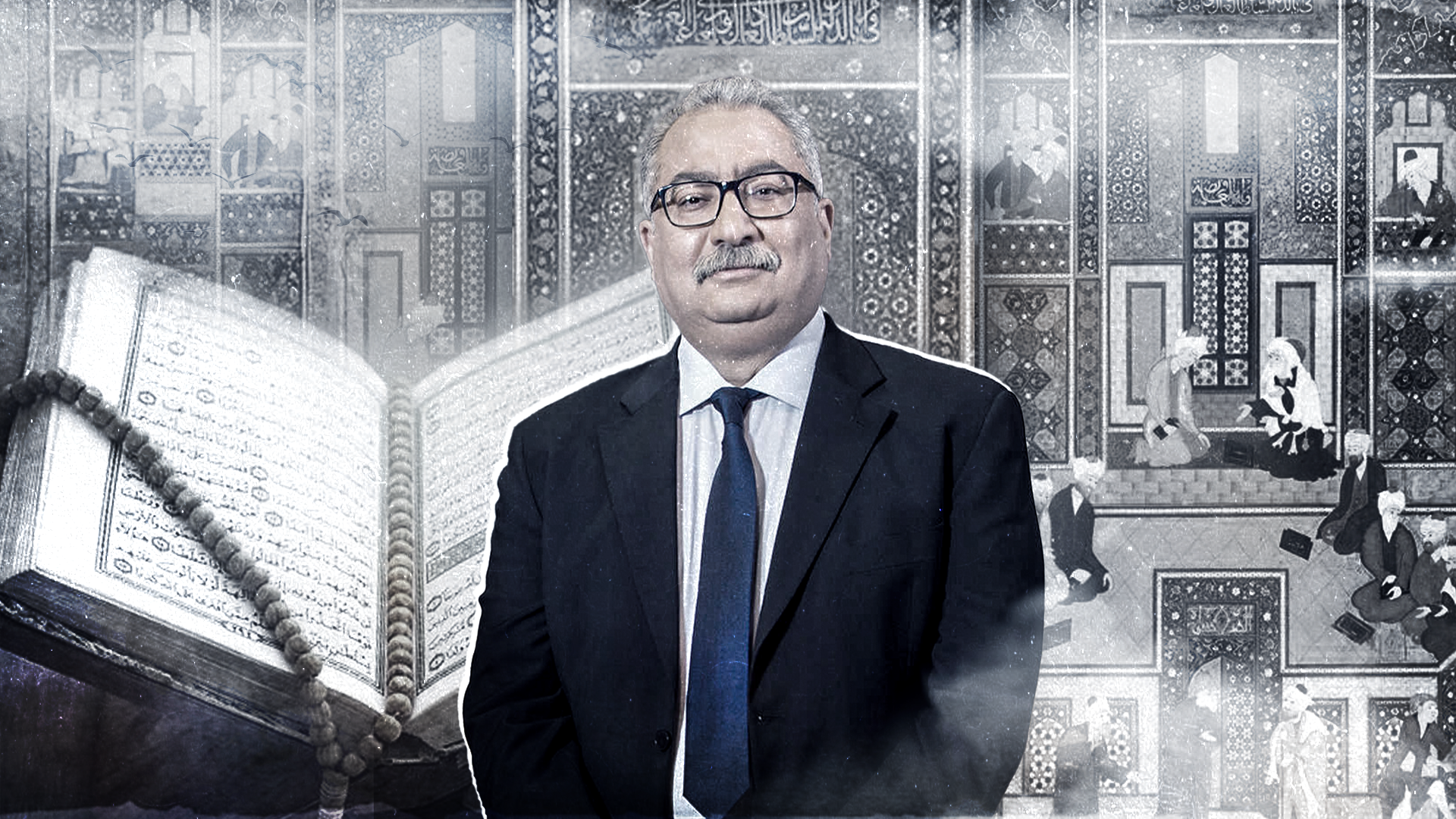
In his weekly show on Alhurra, Writer Ibrahim Essa discussed the concept of “moderate Islam.” The following is the episode’s text, re-edited for easier reading.
We constantly hear the phrase “moderate Islam,” and we are told, “This institution represents moderate Islam,” or “This imam or sheikh speaks for moderate Islam.”
But is there truly such a thing as “moderate Islam”?
The truth is, if you ask the Salafis, the Hanbalis, or the school of thought that has all but dominated the contemporary Muslim mind, they will tell you: No.
“Moderate Islam”? There is deep, broad, and long-standing rejection of both the term and the concept, based on three main claims.
First claim:
Moderate Islam — what does it mean? They say it means “Islam in between disbelief and faith” – as
if “moderate Islam” implies being midway between two zones: the zone of disbelief (as they see it) and the zone of belief (as they define it). Therefore, they reject the term, seeing only one Islam.
Second claim:
They argue that “moderate Islam” is a Western construct — a concept pushed by the West to produce a diluted, distorted version of Islam. In their view, this “moderate Islam” strips the religion of its essence, its strength, and its foundational principles, offering instead a pale, lukewarm Islam.
Third claim:
They say the more accurate term is “the moderation of Islam.”
What they mean is that Islam itself embodies moderation when compared to other religions, which they see as lacking Islam’s balance. The “moderation of Islam,” as they understand it, is its temperance, its guidance for worldly life, its human teachings, and its tolerant principles toward others.
From this perspective, they reject “moderate Islam” — either because they believe it’s a version desired by the West (the supposed enemy of Islam), or by secularists, liberals, and civic-minded Muslims (whom they also deem enemies despite their claim to be Muslim), or because they view it as placing Islam somewhere between disbelief and belief, when to them Islam is pure belief.
Of course, these arguments could be debated — if the goal were discussion rather than judgment, condemnation, and execution of a verdict.
If Islam Is One — Which Islam Is It?
Is it the Islam of Ibn Taymiyyah (who would later be claimed as a forebear by today’s jihadists), or the Islam of Ibn Abd al-Wahhab (whose teachings form the basis of official Islam in today’s Saudi Arabia), or the Islam of the Hanafis (followed by many contemporary Sunnis) or the Malikis (same )?
These are different schools of jurisprudence.
Is it the Islam of the Taliban in Afghanistan, or the Islam of Iran and its Ayatollahs?
Is it Shi’a Islam or Sunni Islam?
Is it Twelver Shi’ism, Zaydism, or Ibadi Islam?
Or is it the Sunni Islam of the Malikis, Shafi’is, or Hanbalis?
Yes, there is such a thing as moderate Islam, precisely because there are multiple concepts of Islam.
There is a vision of Islam that is balanced and moderate — and another that is rigid and harsh.
For example: Ibn Taymiyyah declared nearly all other creeds outside Islam, while the Hanafis do not. The Mu’tazilites (rationalist thinkers in the Middle Ages) never declared other sects or religions to be infidels at all.
Are You Islam?
I tell you: there is a rigid, hardline Islam, and there is a moderate Islam. I tell you: the Muʿtazilites are a form of moderate Islam, and the Ashʿarites can also be considered moderate Islam — whereas the Hanbalis, those who call themselves Salafis or Wahhabis, are not moderate Islam. They represent a rigid, extreme form of Islam.
Therefore, there exists a version called “moderate Islam.”
Consider this: the Al-Azhar University in Cairo, a major source of contemporary Islamic teaching, issues a fatwa permitting peace with Israel, citing the Qur’anic verse “And if they incline to peace…” — affirming that peace is religiously permissible, or that a ruler may conclude a peace treaty with Israel.
Then you have other fatwas — from different sheikhs, institutions, or groups like the Muslim Brotherhood — that prohibit peace with Israel, declaring instead a perpetual war: a war for Islam and against Judaism.
Which of these is moderate?
Even when facing Western colonialism — take Britain’s occupation of Egypt as an example — the one who says: This is Western political occupation by a foreign state that has colonized us, and we must resist it as citizens… is expressing a reasonable concept. But when another emerges with an “Islamic” concept that says: These are infidels, and we must fight the infidels for the sake of Islam, then this is, in your eyes, a religious war, not a national resistance.
The sheikh who tells us, No, we are resisting them because they are colonizers, not because they are Christians… that is a moderate sheikh. But the one who says we resist them because they are Christians, not because they are colonizers… that is a hardliner.
There is moderate Islam — and there is a moderate approach — in every matter.
Anyone who insists there is no moderate Islam, and that there is only one Islam, is an extremist — someone who considers his own extremism, his fanaticism, and his rigidity to be Islam. Such a person refuses to accept any other version of concepts or opinions that differ from, oppose, or challenge the understanding that dominates his mind.
Rifaʿa al-Tahtawi, the Azhar scholar who traveled with the first educational mission Muhammad Ali sent to France, spoke of the close affinity between the religious concepts and objectives of Islam and those of Western civilization. That is “moderate Islam.”
By contrast, there are those who have found great aversion, an enormous gap, between the concepts and civilization of the West and those of Islam.
They agree, on the surface, that there must be moderate Islam [[okay?]]. But they believe that the extremism they preach is “moderation,” and that the fanaticism they spread is “moderation.” And that is the disaster.
It is natural for me to say there is a rigid, hardline Islam, and a moderate Islam. I acknowledge your Islam and recognize that it contains a rigid, hardline, extremist concept — one that can verge on being terrorist in nature. I reject it, condemn it, and fight it — but I accept that it is your version of Islam. I do not strip you of your Islam, nor do I call you an infidel.
You, however, insist that I — who espouse the ideas of Muhammad Abduh, Sheikh Abdel Mutaʿal al-Saʿidi, even Abu Hanifa al-Nuʿman, even the Muʿtazilites — you insist that this is against Islam, that it is not a valid version of Islam, and that there is only one Islam: your Islam, your extremist Islam.
We remained silent until you became the ones seizing control over all other Islamic concepts, claiming that Islam is one domain, one opinion, one jurisprudence, one school — yours.
From there comes takfir — the act of declaring others unbelievers — because those who do not acknowledge “moderate Islam” are the ones who declare unbelievers everyone who speaks of an Islam other than the Salafi, Hanbali, or Wahhabi concepts.
Those who reject the idea of “moderate Islam” are ISIS.
Those who reject the idea of “moderate Islam” are al-Qaeda.
Those who reject “moderate Islam” are Hay’at Tahrir al-Sham, Jabhat al-Nusra, the sons and grandsons of Osama bin Laden.

