
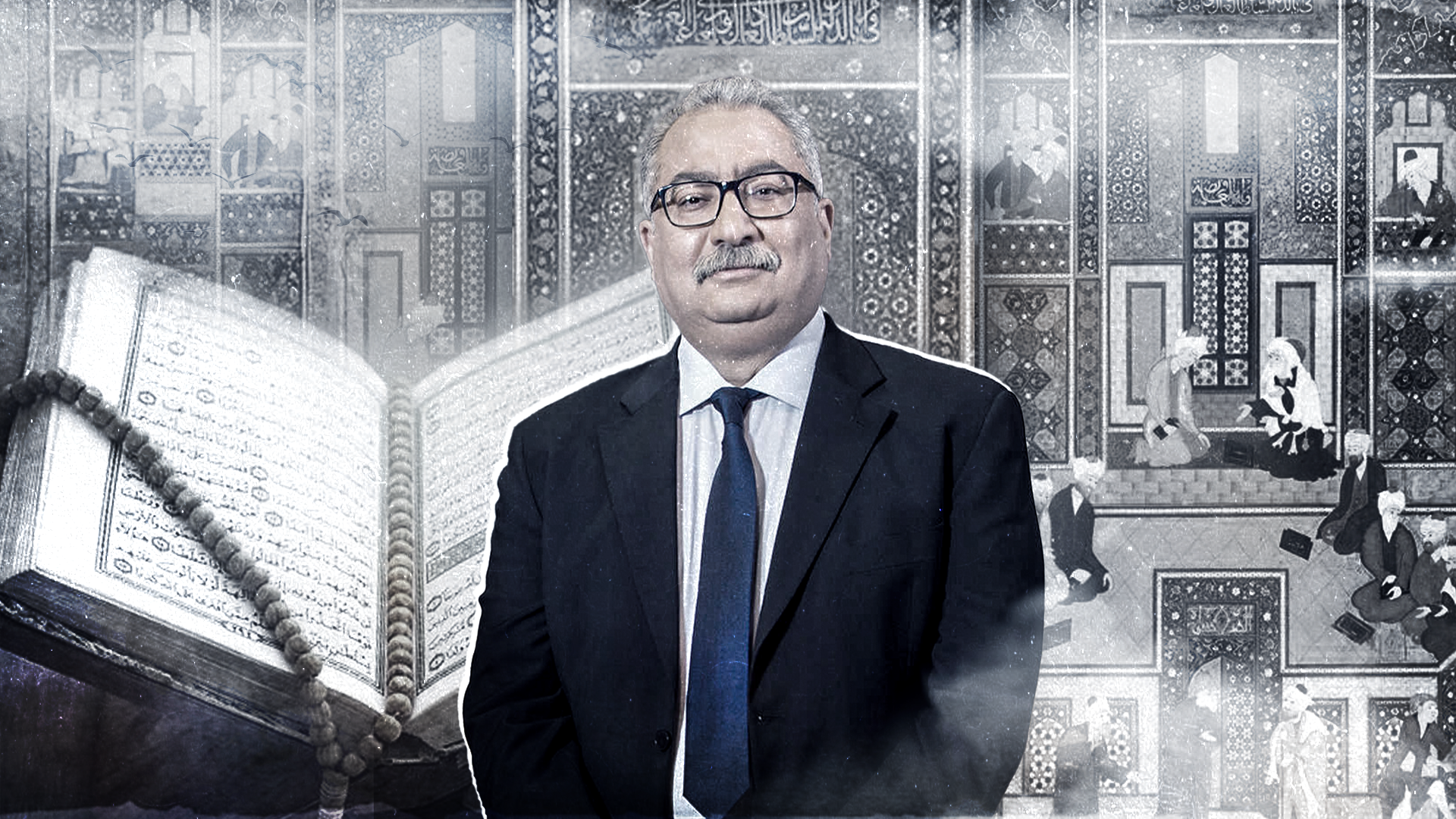
In his weekly show on Alhurra’s digital platforms, writer and journalist Ibrahim Eissa dives into one of the most contentious questions in Islamic history: Religion and politics in Islam. For the outspoken Egyptian commentator, political power in Islam was never divine—it was always political. That is, until the moment “politics laid its hand on religion.”
The following is the episode’s text, re-edited for easier reading.
Just forty-eight hours after the Prophet Muhammad’s death, Islam was drawn into politics.
The Prophet passed away on a Monday and was buried on Wednesday. That same day, His companions, the Ansar and the Muhajirun, gathered to settle the question of succession.
The Muhajirun (“Emigrants”) were the early Muslims who left Mecca with the Prophet Muhammad to escape persecution, while the Ansar (“Helpers”) were the people of Medina who welcomed and supported them, forming together the first united Muslim community.
The meeting to decide Muhammad’s successor took place in the Saqifah (shed) of Banu Sa‘idah, a roofed assembly place belonging to the Banu Sa‘idah tribe in Medina. There, Abu Bakr and Umar ibn al-Khattab—two of the Prophet’s closest companions—arrived and joined a heated debate marked by arguments, raised voices, and sharp exchanges over who should receive the pledge of allegiance.
The Saqifah Debate: Politics Without Revelation
What is striking—when one reads accounts of the Saqifah, whether in Sunni or Shia sources, is that not a single Qur’anic verse or prophetic hadith was cited in that decisive debate.
The conversation was entirely about worldly considerations: reason, logic, partisanship, and power. Religion was absent. It was a political struggle for authority, while religion continued on its own track—worship, law, theology, creed—concerned with the individual’s relationship with God.
Politics, however, would later seek legitimacy, weapons, and persuasion. And it was then that politics entered religion. Religion itself never entered politics; the Qur’an and authentic hadiths never outlined systems of government or political conflict. Politics took religion, seized it, and used it.
The Caliphate: A Secular Struggle in Religious Dress
Consider the succession of Abu Bakr, then Umar, then Uthman (the first three Muslim caliphs), None of these transitions was decided based on scripture. Umar himself devised a remarkable system by naming six men to choose his successor—a purely political mechanism.
The rebellion against Uthman (the 3rd caliph) too, was political. His critics opposed his policies, his appointment of relatives to governorships, and questions of wealth distribution. Religion was not the issue.
Even the conflict between Ali (The 4rd Caliph) and Mu‘awiyah (the founder and first caliph of the Umayyad Dinasty) centered not on faith but on politics. Mu‘awiyah demanded retribution for Uthman’s murder. Later, Mu‘awiyah sought to turn the caliphate into hereditary monarchy by naming his son as successor—a political act resembling the Caesars and Sassanid kings, not a decision grounded in revelation.
The Birth of Sects: Politics Creates Theology
Out of these struggles emerged sects. Supporters of Ali—later known as the Shia—responded to defeat and persecution under the Umayyads by building a religious doctrine around their political cause. Over time, oppression by Umayyad Caliphate (established in 661 CE) and Abbasid Caliphate (established in 750 CE) deepened these beliefs into a distinct theology.
The other side, too—the Umayyads, Abbasids, and what became the Ahl al-Sunnah (the major sect within Islam)—constructed their own religious framework to legitimize power. Politics used religion as a weapon, branding opponents as unbelievers or heretics, and executing them in the name of faith when the disputes were political.
The Ottoman Example: Declaring Muslims Infidels
Centuries later, when the Ottomans expanded, Sultan Selim I invaded Egypt. His motives were political: a strong empire swallowing a weaker one. But Egypt was ruled by the Mamluks—Muslims.
How to justify attacking fellow Muslims? Selim secured a fatwa declaring the Mamluks infidels, absurdly on the grounds that they stamped images on their silver coins. Thus, conquest was framed as an “Islamic war,” when in truth it was straightforward expansionism.
Modern Times: The Politics of Hakimiyya
In the modern era, the same pattern continues. The doctrine of hakimiyya (“sovereignty belongs to God”), developed by Pakistani Islamic scholar Abul A‘la Maududi (1903-1979), adopted by Sayyid Qutb, a famous influential Egyptian ideologue who established the theoretical basis for radical Islamism, and embraced by the Muslim Brotherhood and its founder Hasan al-Banna, Osama bin Laden (Al-Qaeda founder), Ayman al-Zawahiri (its second leader), and Hamas, represents another attempt to use religion for politics.
The slogans are familiar: “God’s rule must be established,” “Shari‘a is absent,” “Society is corrupt,” “The ruler is an unbeliever.” These claims are not theological revelations but political tools, designed to seize power.
Why They Reject Separation of Religion and State
So, does Islam itself prescribe politics? No. Neither Islam, Christianity, nor Judaism provides a system of politics. It is politics that co-opts religion.
And yet, when someone says: “There is no religion in politics and no politics in religion,” they are branded an unbeliever. Why? Because such a statement robs political actors of their most powerful weapon—religion as a tool of domination.
The cry that “Islam is both religion and state” serves one purpose: to justify political control. They cannot tolerate the idea that “Islam is a religion, while the state is civil,” because that strips them of their means of power.
This is why they demand you accept that Islam includes politics. To deny it is to invite their threats of violence.

