


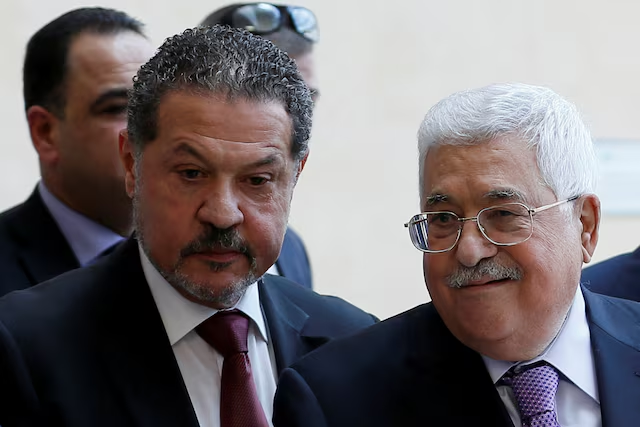
For years, Yasser Abbas, the son of 90-year-old Palestinian President Mahmoud Abbas, was known primarily as a businessman rather than a politician. But earlier this year, following a series of political assignments, he was elected to Fatah’s Central Committee, the movement’s highest leadership body.
His ascension has fueled speculation that he was brought into the committee to position him as his father’s successor. Before the vote, one Fatah official told Reuters that a seat on the Central Committee was “the beginning” and that Yasser Abbas would eventually seek a spot on the Palestine Liberation Organization’s Executive Committee.
From there, he would be able to wield influence over the PLO and over who would become president after Mahmoud Abbas—a powerful position for someone who has spent most of his professional life outside the movement’s senior leadership.
But Yasser Abbas’s possible path to the Palestinian presidency is hardly assured. Under new rules that his father put in place, Hussein al-Sheikh, the vice president and deputy chairman of the PLO’s Executive Committee, would serve as interim president if the office became vacant. And veteran leaders with deeper roots in the Palestinian movement also won seats on Fatah’s Central Committee.
The bigger question may not be whether Yasser Abbas inherits his father’s office, but what his rise says about the Palestinian Authority. The United States and Gulf donors have tied any larger role for the Palestinian Authority, including in postwar Gaza, to reform, cleaner governance, less patronage and holding elections. Two months before Palestinians are scheduled to vote on Nov. 28 in their first legislative election in two decades, the president’s son, whose companies once drew scrutiny over U.S.-funded contracts, now sits on the body that will help decide who leads after Mahmoud Abbas.
A Business Legacy That Follows Him into Politics
Yasser Abbas enters public politics with a long history in business. The Palestinian-Canadian businessman controls companies and investments in sectors including construction, telecommunications and tobacco in the Palestinian territories.
For years, he and his brother, Tarek, have faced accusations from critics that they used their family connections in their business dealings. Both men have denied the allegations.
In 2009, media reports focused on contracts awarded in 2005 and 2006 to companies linked to Abbas’s sons and funded by the U.S. Agency for International Development. In 2012, Yasser Abbas sued Foreign Policy magazine and an American analyst for defamation over an article questioning whether the family had profited from U.S. aid. A U.S. federal court dismissed the case. The agency and the family’s lawyers said at the time that the contracts had followed normal procedures and involved no favoritism.
These controversies did not prevent Yasser Abbas from being elected to the Central Committee, but he is likely to remain under scrutiny.
MBN contacted Yasser Abbas for comment but did not receive a response.
From Business to Fatah Leadership
Recently, Yasser Abbas began appearing more prominently beside and, sometimes, in place of his father.
In June 2026, he represented Mahmoud Abbas in meetings with officials from the United Nations Relief and Works Agency for Palestine Refugees in Beirut. He also met Lebanese Prime Minister Nawaf Salam to discuss the issues of Palestinian refugees and weapons in the camps.
He has accompanied his father on foreign visits and at diplomatic meetings, including a trip to Moscow, where he joined a meeting with Russian President Vladimir Putin and other officials.
But until his election to Fatah’s Central Committee, he had never held an official position. Now he sits at the highest levels of leadership.
His transition from businessman to political operative has drawn criticism from opponents of the president and some Palestinian oversight institutions.
Dimitri Diliani, a spokesperson for the Democratic Reform Current, a breakaway Fatah faction led by a rival of Mahmoud Abbas, told MBN that Yasser Abbas’s rise reflected the president’s influence over the movement’s institutions and criticized how its leaders were selected.
Jihad Harb, a political analyst who has researched Palestinian governance for the anti-corruption watchdog group AMAN, told MBN that the absence of clear standards for some official appointments raised questions about the limits of authority and potential conflicts of interest.
A Rise That Does Not Mean Succession
In April 2025, in response to pressure from the United States and Arab states to overhaul its institutions and clarify who would lead after Mahmoud Abbas, the PLO created the post of vice president. Mahmoud Abbas then named al-Sheikh to that office as well as appointing him deputy chairman of the PLO Executive Committee.
In October that year, Mahmoud Abbas issued a constitutional declaration stipulating that the deputy chairman and vice president would serve as interim president for up to 90 days if the office became vacant. Elections would be held in that three-month period.
But the rules decide only who holds the office temporarily, not who ultimately succeeds Mahmoud Abbas. Several veteran leaders who won Central Committee seats with Yasser Abbas have longer records inside the movement, and a seat on the committee, while significant, does not by itself make its holder a front-runner.
Yohanan Tzoreff, a researcher on Palestinian affairs at Israel’s Institute for National Security Studies, told MBN the main obstacle to any leadership ambitions by Yasser Abbas would be internal, given the presence of Fatah figures who regard themselves as having greater political and organizational experience. Yasser Abbas does not yet have an independent political base large enough to make him an automatic candidate to succeed his father, Tzoreff said.
A Test of Legitimacy Inside Fatah
The scheduled Nov. 28 vote is for the legislature, not the presidency, which has not been contested since 2005. Since then, the rules governing the transfer of power have changed without a single vote being cast on the matter. This makes the competition inside Fatah even more important in deciding who next leads.
Thus, Yasser Abbas’s entry into the Central Committee could prove significant even if it is not a direct path to the presidency.
A seat on the Central Committee is more than symbolic. The committee is one of the key institutions that will help shape Fatah’s future, in a movement that dominates the Palestinian Authority and is the principal political force within the PLO. That matters in Washington, where U.S. assistance to the Palestinians is subject to conditions set by Congress, including the Taylor Force Act, which bars U.S. economic aid that directly benefits the Palestinian Authority so long as it continues to compensate individuals imprisoned for acts of terrorism and the families of deceased terrorists. And it is the kind of institution donors say must change before the Palestinian Authority takes on a larger role in postwar Gaza.
For Yasser Abbas, the seat marks a real shift: He is no longer simply the president’s son appearing alongside him at meetings, or a businessman operating outside the movement’s formal structures. He now has a seat at the table in Fatah’s most powerful body just as donors are demanding cleaner governance and less patronage.
How he uses it could say as much about the future of the Palestinian Authority as about his own ambitions.
Adapted and translated from the original Arabic.


