
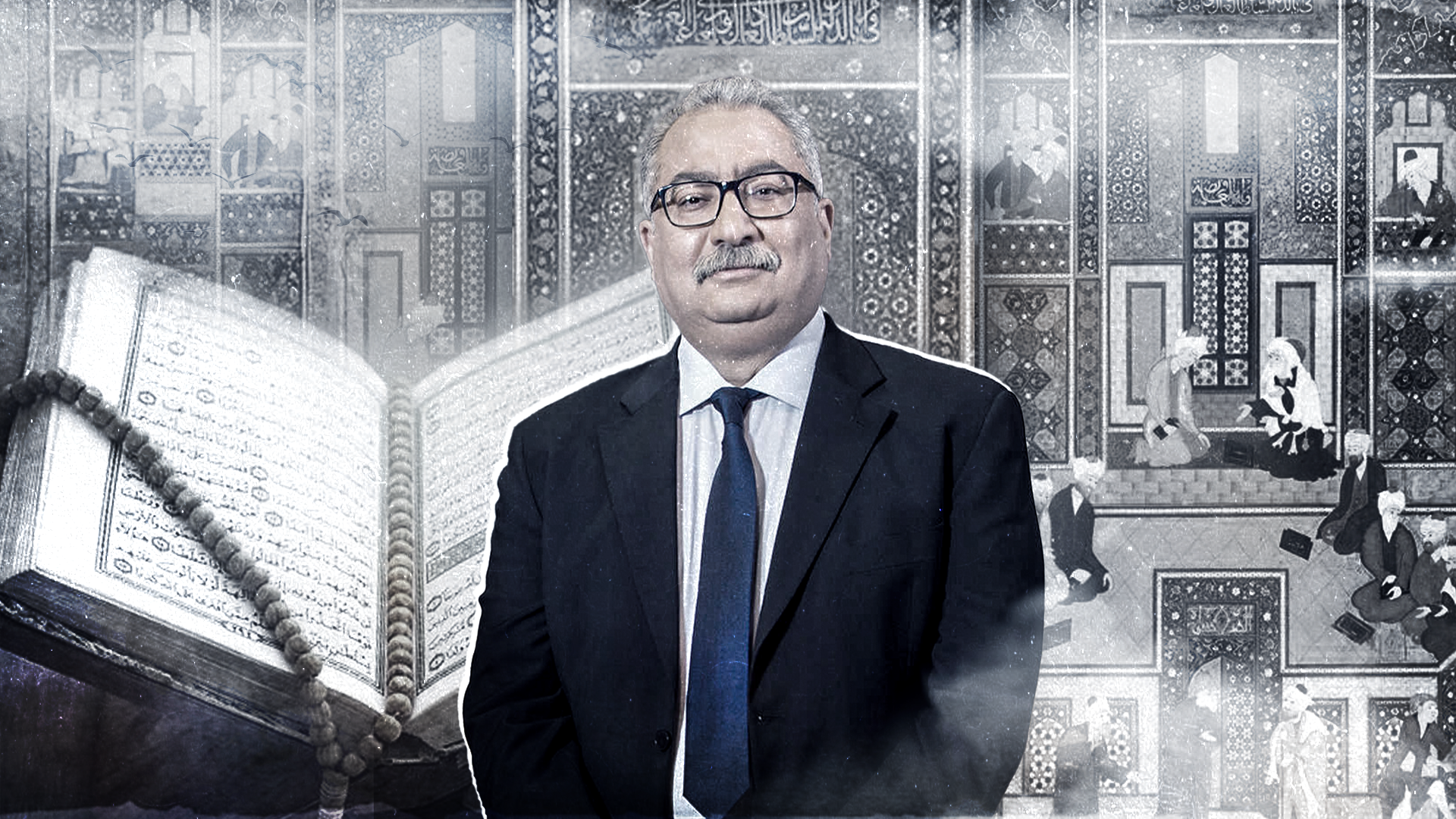
In his weekly commentary on Alhurra’s digital platforms, writer and journalist Ibrahim Essa examines what he calls the “impossible relationship” between Islamist movements and the civil state. He argues that the notion of integrating political Islam into a modern civic framework is a Western illusion – one born of a fundamental misunderstanding of these movements’ nature.
Essa contends that the roots of the problem are ideological rather than political: Islamists believe in divine sovereignty (hakimiyyah), while a civil state is built on popular sovereignty. Any effort to reconcile the two, he says, is not reform but self-deception – political and intellectual alike.
Oil and Water
Let me start with a simple image: water and oil.
You can shake them together all you want, but they will never mix. That’s exactly how it is with Islamists and the civil state.
All this talk about “containing” Islamist movements within a civil state – that a civil system can both uphold democratic pluralism and restrain political Islam – is pure fiction.
This fantasy is largely Western. The West dreams big – and in this case, it bought into a false bargain sold by Islamists: that there can exist an Islamist current that believes in democracy, respects civil life, yet still applies its religious ideology. The Western left, in particular, bought this illusion wholesale. It never spoke to those who truly understand these movements from within Islamic culture itself.
Driven by a desire to disprove the right or to romanticize “forces of change,” even if extremist, this Western current insists on legitimizing political Islam – a mistake that reveals a deep ignorance of the doctrinal roots of the conflict.
Our position remains clear: no political Islamist movement can ever be truly integrated into a civil state. There is no future for any attempt to “normalize” the Muslim Brotherhood or similar groups within democratic politics. Democracy, by its very nature, cannot coexist with them.
Some argue otherwise – pointing, for instance, to the recent talk of “moderating” jihadist figures such as Abu Mohammad al-Julani, now Syria’s President Ahmed al-Sharaa. But let’s be clear.
Al-Julani and the Attempt to Tame Terrorism
Al-Julani is a terrorist.
His organization is listed by the United States as a terrorist group, and he himself had long been on America’s wanted list, with a bounty on his head.
And yet some decided to dress him in a suit – to claim that even the most extreme branch of political Islam, the militant one, can somehow be civilized and folded into a modern state.
We are expected to applaud this as “progress” – to see it as a clever rebranding of political Islam. The same argument is made about the Muslim Brotherhood: that they can play by the rules of civil politics. Turkey under Recep Tayyip Erdogan is held up as proof that Islamists can coexist with democracy.
And now, on this stage, comes the newest performer: Mr. al-Julani.
To bring terrorists under the umbrella of political legitimacy is not “reform.” It is the normalization of extremism – an act that trivializes its danger and invites it into the civic sphere. Such acceptance allows Islamists to use democracy as a tool to seize power – and then dismantle democracy itself.
This is not integration. It’s a trap.
Roots of the Ideology
We must be clear about the foundation of this ideology. Much of the confusion stems from ignorance – from not knowing the core ideas of these movements.
When you talk to Islamists – as a politician, or even as an ordinary citizen – you often hear vague, reassuring words. Without studying their history or understanding their intellectual lineage, you might even believe they’ve changed.
Many once assumed that the Muslim Brotherhood had accepted democracy – that it would become a conservative, right-wing party operating within a civil framework. But that was wishful thinking.
The Islamist right, like the Israeli right, seeks to sacralize politics – to turn the state itself into a religious project.
Let’s go back to the roots.
To call yourself an Islamist – whether Salafi, Brotherhood, or Julani-style – you must adhere to certain non-negotiable principles. Chief among them is al-hakimiyyah, the belief that sovereignty belongs solely to God.
But if divine sovereignty is absolute, and the people’s sovereignty is the foundation of the civil state, the two are irreconcilable. Any “compromise” between them is tactical, not ideological.
And if an Islamist truly abandoned that principle, he would cease to be an Islamist at all.
This rejection of the civil state extends to the very notion of the nation itself. Consider what the founders of these movements have said. Hassan al-Banna, the Brotherhood’s founder, once declared: “The homeland is nothing but a handful of filthy dirt.” Mahdi Akef, another Brotherhood leader, famously said: “To hell with Egypt.”
Such statements reveal a worldview that rejects the concept of the nation-state altogether, replacing it with allegiance to the transnational umma and the dream of an Islamic caliphate.
How, then, can one integrate into a civil, national state when one denies both the nation and the civility that define it?
The Illusion of Moderation
It is astonishing that, after everything we’ve seen, some still speak of integrating Islamists into a civil order.
Look at Iran – the “Islamic Republic” built by Ayatollah Khomeini. It offers a living example of what happens when Islamists seize power: the state becomes an instrument of religious rule, stripped of democracy and civil life.
Yes, there may be elections – limited, controlled, and theatrical – but they are nothing more than musical chairs within a closed theocracy.
The same happened with Hamas. After winning the 2006 Palestinian elections, Hamas seized control of Gaza and has not held a single parliamentary, union, or even student election in 16 years.
Both Iran and Hamas illustrate the same principle: for Islamists, democracy is not a value but a vehicle – a ladder to power. Once in control, they kick it away. The result is not a civil state but a religious autocracy – a form of fascism cloaked in faith.
Even in Turkey, what survives today is not Islamist governance but the resilience of Atatürk’s secular republic. What has kept Turkey intact is not Erdogan’s success but the enduring strength of its secular institutions.
Can Islamists Exist in a Civil State?
This is the fundamental question – and it is directed not only at Arab readers but also at Western intellectuals and policymakers:
Can Islamists form parties, run for office, and govern within a civil state while rejecting its very foundations?
Would Western societies tolerate the existence of political parties that seek to abolish citizenship and create hierarchies among citizens?
Would any European or American accept the idea of coexisting with a party modeled on Nazism or fascism – one that preaches exclusion and enshrines religious supremacy?
Yet, paradoxically, many in the West who denounce the far-right at home – who recoil at anti-immigrant rhetoric – are the same voices urging Arabs to “accommodate” Islamist movements that want to drive Christians and Jews from their homelands.
What hypocrisy.
We are not talking about ancient history but about contemporary, visible realities. Every time Islamists have governed, civility has died, and democracy has vanished.
The Cruel Choice
Some will object: But we live under authoritarian regimes.
True.
But it is a grave mistake to justify acceptance of religious tyranny as a remedy for political tyranny – as if one could cure cancer by replacing it with another.
It’s like saying: “Since Bashar al-Assad is a dictator, let’s try al-Julani instead.” That’s not a cure; it’s a death sentence.
I reject political despotism – but I reject religious despotism even more. If forced to choose between two evils, I would choose political authoritarianism – reluctantly.
Why? Because religious tyranny inevitably breeds political tyranny as well. Political autocracy, by contrast, might – in rare moments – leave a narrow space for social or religious freedom.
We are witnessing a tragic absurdity: a persistent campaign to disguise Islamist movements as “civil political forces” capable of governing a modern state. It is a delusion.
Let’s be clear: Political Islam is authoritarian by definition.
The Muslim is one thing; political Islam is quite another.
And political Islam – as an ideology –is the catastrophe itself.
Oil and water do not mix.
Islamist thought and the civil state will never coexist no matter what the seduction, deception, or manipulation deployed to make us believe otherwise.

