Inside the World’s Largest Library
How the Library of Congress Became Part of Everyday American Life

Inside the World’s Largest Library
- Photo essay by
- Lara Ajami

I expected distance. Marble. Authority. A place you approach carefully, knowing it was built to last, not to welcome.

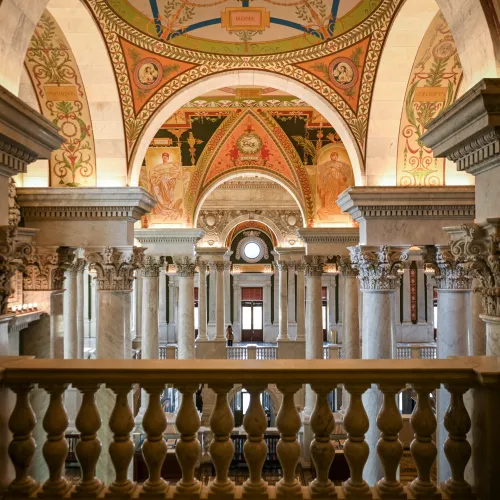
Inside, that expectation fell short. Most people weren’t there to read or research, but to look up, pause, and photograph the hall itself. At the same time, two bridal photo sessions were taking place inside the library, an entirely unexpected sight.

That is not how the Library of Congress originated. Founded in 1800, it began as a small, exclusive collection intended to serve lawmakers rather than to welcome the public.

In 1814, during the War of 1812, British troops set fire to the United States Capitol, completely destroying the library and leaving the nation without its written record.

That’s when Thomas Jefferson, the third U.S. president, stepped in. He sold Congress his personal book collection to rebuild the library. It reached beyond politics, redefining what knowledge a democracy needs.

As the collection grew, it outgrew the Capitol. In 1897, the Thomas Jefferson Building opened, providing the Library a dedicated home. Knowledge was no longer confined to government offices; it was given space to stand apart.

At the center of that space is the Main Reading Room. Access is controlled. Readers must register, request materials, and work under supervision.

The library also features public exhibition spaces. A selection of manuscripts, maps, photographs, and documents is showcased for a limited time. Afterward, they are returned to secure storage, where most of the collection is kept inaccessible.

By the time I left, the weddings made sense. The surprise wasn’t the couples. It was how far my idea of the library had fallen behind what it has become.

I expected distance. Marble. Authority. A place you approach carefully, knowing it was built to last, not to welcome.

Inside, that expectation fell short. Most people weren’t there to read or research, but to look up, pause, and photograph the hall itself. At the same time, two bridal photo sessions were taking place inside the library, an entirely unexpected sight.

That is not how the Library of Congress originated. Founded in 1800, it began as a small, exclusive collection intended to serve lawmakers rather than to welcome the public.

In 1814, during the War of 1812, British troops set fire to the United States Capitol, completely destroying the library and leaving the nation without its written record.

That’s when Thomas Jefferson, the third U.S. president, stepped in. He sold Congress his personal book collection to rebuild the library. It reached beyond politics, redefining what knowledge a democracy needs.

As the collection grew, it outgrew the Capitol. In 1897, the Thomas Jefferson Building opened, providing the Library a dedicated home. Knowledge was no longer confined to government offices; it was given space to stand apart.

At the center of that space is the Main Reading Room. Access is controlled. Readers must register, request materials, and work under supervision.

The library also features public exhibition spaces. A selection of manuscripts, maps, photographs, and documents is showcased for a limited time. Afterward, they are returned to secure storage, where most of the collection is kept inaccessible.

By the time I left, the weddings made sense. The surprise wasn’t the couples. It was how far my idea of the library had fallen behind what it has become.


