
Dear Colleagues,
This spring, IShowSpeed, aka Speed, did the Chinese Communist Party an enormous favor. The 20-year-old YouTuber from Cincinnati, Ohio — whose real name is Darren Jason Watkins, Jr. — live-streamed tours of Chinese cities over two weeks to his nearly 40 million viewers. The result?
Large numbers of young Americans and followers around the world were unable to catch even a glance of China’s police state. There was no hint of secret trials, political prisoners, gulags for Muslim Uyghurs, executions of dissidents, or intensifying persecution of Christians. What tens of millions were treated to instead was China looking cool with awesome eateries, safe and spotless streets, dancing in parks, a burgeoning electric car scene, and free high-speed Wi-Fi on the subway.
Of course, China has been leaning into soft power. Beijing has been expanding its influence through the Belt and Road Initiative, through development loans, through university programs for international students at home and well-resourced media operations abroad. There are hit video games, films, and viral apps streaming out of the country. There’s vision and strategy driving much of this.
The Communist Party has become particularly adept at taking advantage of our passion for profits, for celebrity, for free markets and free speech. Witness the warm welcome Beijing extended to IshowSpeed.
“IShowSpeed doesn’t know anything about politics and doesn’t want anything to do with politics,” our colleague Ringo tells me. What luck for America’s authoritarian adversaries.
Chinese vision and strategy
The proper campaign for cultural soft power started in 2007 at the 17th National Congress, when then-President Hu Jintao announced that “We must enhance culture as part of the soft power of our country.” The aim, said the Chinese president: to enhance the influence of Chinese worldwide.
A decade later, during the 18th National Congress of the Chinese Communist Party, Xi Jinping called for “an increase in China’s soft power.” The Chinese narrative had to get out to the world, Xi stressed.
For a number of years now, the United States and its allies have been confronted with daunting soft power updates. “Sharp power,” as coined by Christopher Walker and Jessica Ludwig of the National Endowment for Democracy, is the information warfare waged by China and Russia. Russia is good at this. China is better and has deeper pockets.
Beijing spends billions of dollars, including on media operations — exact figures are unknown — to shape the perceptions of publics and influence decision makers around the world.
Sharp power requires patience and a multi-faceted strategy. Chinese President Xi Jinping was on the road this spring meeting with leaders in Vietnam, Cambodia and Malaysia. President Xi walked away with agreements for railroad connections in Vietnam, for energy, education and infrastructure projects in Cambodia, and for technical and manufacturing exchanges in Malaysia. In May, China hosted the China-Latin American and the Caribbean Forum, announcing it would provide a $9 billion credit line and new infrastructure investments for the region.
For years, former Secretary of Defense Robert Gates has been emphasizing the importance of non-military instruments to advance U.S. foreign policy objectives. In the Wall Street Journal last month, Gates argued that only through a combination of economic power, technological advantage, humanitarian and developmental assistance, and strategic communication will the U.S. be able to take on the evolving Chinese threat. Gates quotes China’s warrior philosopher Sun Tzu: “The supreme art of war is to subdue the enemy without fighting.”
Enter MBN
U.S.-funded international media advances American foreign policy goals in a unique and exceptionally valuable way. We’re not propaganda. We’re not the mouthpiece of any particular government agency. That’s hard for those bent on tight control to understand.
Yes, absolutely: Taxpayer-funded international media must align with U.S. national security objectives. But it’s the integrity of our journalism, the striving for honesty, accuracy, and truth, that sets us apart. It makes for credibility. And it’s credibility that translates into impact. That’s the American secret sauce.
Here’s Rob Coalson’s interview with me in Greg Feifer’s online magazine Compass on daunting challenges and real opportunities. We’re thinking fresh about America’s voice in the world. This, too, is difficult for our critics to appreciate: Our striving for truth does not stand in contradiction with our work’s bias toward America and affection for our region.
In this spirit, at MBN we’re focused on:
- U.S. reporting. With our unparalleled access, we tell stories other Arabic-language news outlets cannot or will not share about U.S. politics and society. We’re America’s voice in the Middle East. MBN’s Alhurra can beat Al Jazeera.
- Tech and innovation. Bold ideas and breakthrough technologies are radically transforming the way we live and think about the future. It’s here in the U.S. and across the Gulf. In Israel, too. We cover change.
- Society, religion and culture. We dive deeper. We respect the profound importance of family, faith, and education in shaping societies. We care for rule of law, human rights, and decent accountable government. We shine light on the roots of extremism.
- Iranian influence. We inform Arabic audiences about the Iranian regime’s destabilizing impact across the region. For decades, the Islamic Republic has been a persistent threat to regional stability in the Middle East. We cover Iran’s nuclear work, its network of radical proxies, and its regional ambitions.
- Chinese ambition. We pursue stories other outlets avoid. Beijing continues to expand its diplomatic and commercial influence across the Middle East. China undermines American influence.
Last week, the Iranians huddled up with the Chinese and Russians in Tehran. China’s foreign ministry scolded the Americans for bombing Iranian nuclear facilities.
Along with Russia, China is relentless in advancing anti-American narratives. No, Mr. Xi, the United States is not a dangerous hegemon in irreversible decline with collapsed social and moral values. Chinese media operations in the Middle East include the Arabic service of China Global Television Agency (CGTN) and the Arabic version of the Xinhua news agency.
And so we’ve sharpened our focus at MBN. We keep raising our game with new talk shows, podcasts, and a digital first strategy. We’ll launch a new newsletter this week — with a suite of sharp, original, policy relevant letters to follow.
We’ve been forced to radically reduce the size and scope of our operations. But our fight with USAGM for Congressionally appropriated funds does not slow us down. Anti-American narratives pushed by U.S. adversaries must be countered.
MBN has allies and a coalition that grows. We’re urging influential partners to think big with us, reimagine strategically, and recognize our unique value. It’s something to build on.
Let’s hold our next town hall meeting next week (the week of August 4). I’ll order food and we can break bread after. Stay tuned for date and time.
Great work, dear colleagues. I’m passionate about our mission, vision, and values. Let’s keep at it.
Gratefully, Jeff

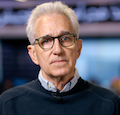
Dr. Jeffrey Gedmin
Dr. Jeffrey Gedmin is the President/CEO of MBN. Prior to joining MBN, Dr. Gedmin had an illustrious career as president/CEO of Radio Free Europe/Radio Liberty, President/CEO of the Aspen Institute in Berlin, president/CEO of the London-based Legatum Institute.
