
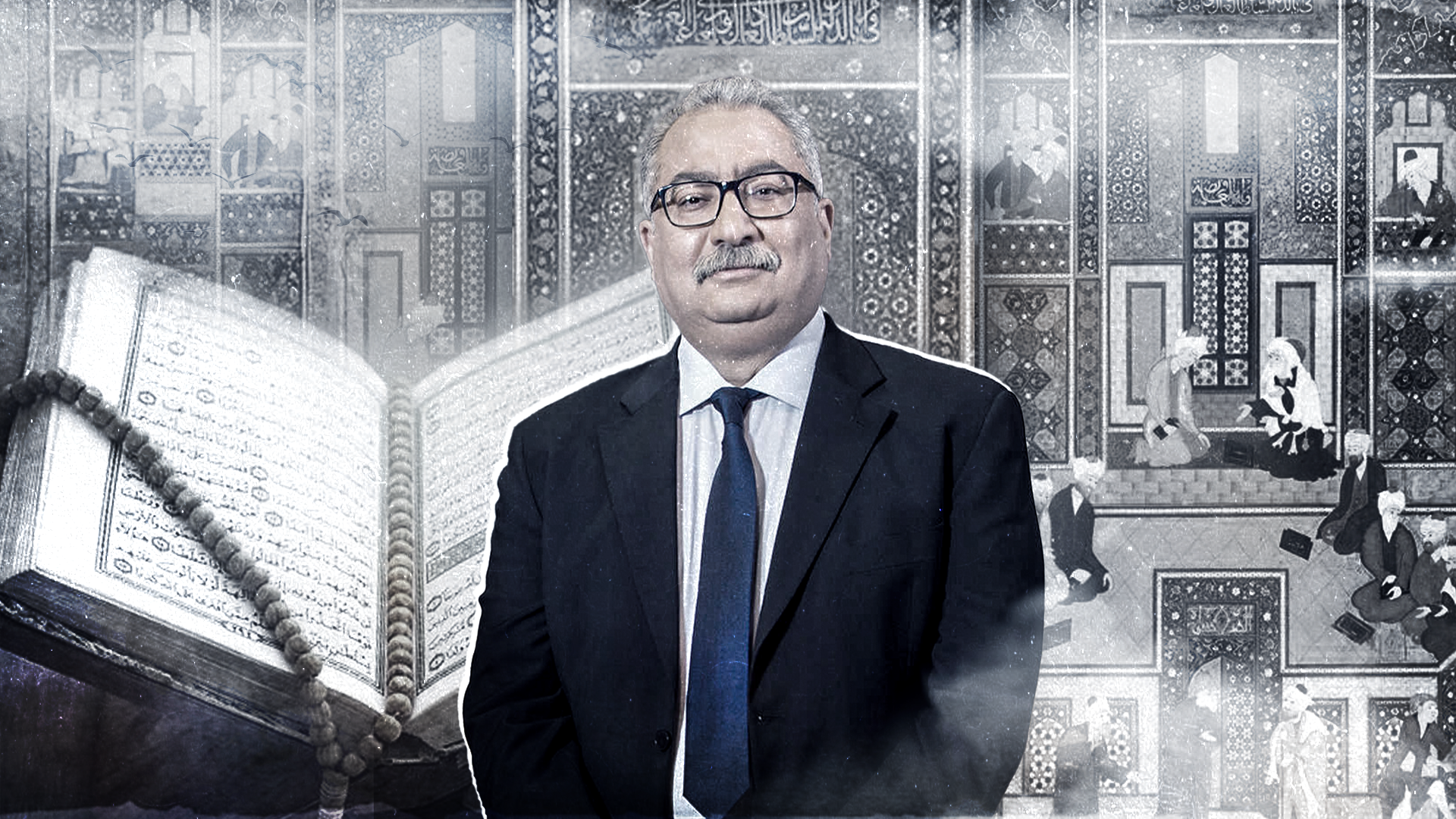
In his weekly episode on Alhurra’s digital platforms, writer and journalist Ibrahim Essa reflects on what he calls “superficial religiosity.” He asks: How did faith change from a core that underpins morals and behaviors to outward manifestations that are used to judge people? Essa argues that for decades, Islamist movements have focused obsessively on “outer guidance” — the veil, the beard, the robe, and standardized religious language; an obsession that turned religion into a uniform rather than a spiritual value and created a society that measures piety by appearance.
The Egyptian writer examines how showing off piety at workplaces, the use of loud microphones, and the flood of pre-packaged religious messaging have all become part of a shallow religious culture that masks genuine corruption and promotes false piety.
Below is a summary of the episode’s main ideas, edited for easy reading.
The Reign of Appearance
Islamist groups have become excessively preoccupied with what they call “outer guidance” — the visible signs of religiosity and adherence to forms. To the point, Essa says, that one could describe today’s social reality as dominated by superficial religiosity — which, in his view, is the true expression and embodiment of religious hypocrisy. Once these groups gained influence in society, they began to confuse the Muslim mind by inventing expressions that are meant to divide and label people. For instance, they minted and popularized the term “tabarruj” (“immodesty”) to describe a woman who is not wearing the veil — a label that became an expression of insult and degradation, implying that she is not truly faithful or observant of Islam.
They created a language of exclusion based on appearance. Why? Because the goal was to enforce a visual religion. For instance, they would say, “This sister is unveiled,” and soon that phrase became central in the sermons, lectures, books, and speeches of Islamist preachers — a ready-made condemnation of any woman not wearing the hijab or niqab (head-and-face cover, or head-and-face-and full body cover). The label itself was meant to demean. The message was clear: for a woman to be considered Muslim, she must look Muslim — veiled or covered. The outward appearance became the criterion of faith. But, Essa argues, that assumes Islam is fundamentally about appearance. “In my view,” he says, “the hijab is not a religious obligation, nor is it one of Islam’s pillars.”
He cites Dr. Saad Eddin Hilali, a respected Islamic thinker, who considers the hijab a jurisprudential rule rather than a divine one. There is no verse in the Qur’an — explicitly or implicitly — that obliges women to wear it as a religious duty. As for claims that Islamic texts prohibit showing anything but the face, hands, and feet, they rely on very weak hadith (sayings attributed to Prophet Mohammed). Even Salafists (Islamic fundamentalists) admit lacks authenticity. Thus, Essa argues, this is all about form, an obsession with outward appearance. Islamists, he says, are fixated to the point of mania on visible markers of religiosity. As a result, religion itself has been reduced to a mere surface: the measure of piety is now the looks.
What happens next? The woman is told to wear the veil — ideally, the niqab. The man grows his beard and wears a jellabiya (a full body robe showing the lower parts of feet. These are often mass-produced in China yet bestowed with a sacred aura as if they came from Mecca itself). The so-called “Afghan” or “Pakistani” outfit — the short robe with pants underneath — is promoted as the “proper Islamic dress.” Why? Because they seek symbols — visual signs of identity and power. Through them, they succeeded in penetrating society and convincing people that Islam is a religion of appearances, that piety is merely outward appearances. The unveiled woman is branded immodest, while the bearded man in a robe is pious. Thus, they distributed ready-made molds, enforced uniformity, and imposed patterns.
This is why they are deeply stereotypical — Salafists in particular. As I showed in my film “Mawlana (out revered Imam),” the clerics of these groups appear in identical outfits: white shawl, white robe, long chest-covering beard, clean-shaven mustache — even their tone of speech is standardized, formal Arabic delivered with the same rehearsed intonation. They literally built a uniform for themselves. Look at anyone belonging to these Salafist movements: you’ll find a nearly identical outfit — short white robe, white trousers, thick untrimmed beard, sometimes with kohl around the eyes. They have become a visual pattern — a model of religiosity based entirely on external appearance rather than inner substance.
False Piety
This superficial religiosity also manifests in daily life — for example, in public prayer during office hours. You’ll see someone perform ablution, water dripping from his hands, then he says : “Excuse me, I’m going to pray Dhuhr, (noon prayer)” even though the prayer time is flexible and there’s no need for a public congregation in the hallways of government offices. Who said Islam requires that? For him, it’s all about display; he just wants to look devout, even if it’s only superficial. What’s odd, Essa notes, is that many of those most eager to pray in public and display their religiosity are the same people who then return to their offices and take bribes. That is a form of religious hypocrisy. A large part of this performative piety serves to justify real corruption. Many corrupt individuals are the loudest preachers of religion — the most eager to go on pilgrimage (Hajj) or Umrah (an abridge type of Hajj), to follow famous clerics, to plaster their photos on their cars. It is religiosity reduced to just images. And they say to you: “Their mark is on their faces.” They interpret this Qur’anic verse as referring to the dark prayer mark that appears on many Egyptians’ foreheads. But if that were the intended meaning, why don’t we see it on the faces of Muslims in Indonesia — the world’s largest Muslim country — or in Mecca and Medina themselves? The mark clearly depends on skin type, the floor surface, or local environment. Does that mean the other billion Muslims don’t pray? Of course not.
Still, people continue to use this superficial measure: “He’s a good man — look, he has the prayer mark on his forehead.”
Such talk has nothing to do with true piety. Even Arab television dramas reinforce this idea. Watch any series about the early days of Islam: the unbeliever is depicted as rough, disheveled, with wild hair and harsh features, while the believer appears neatly groomed, bearded, and dressed in white. Physical beauty becomes a symbol of faith, ugliness of disbelief — a false and dangerous simplification. In truth, many humble-looking people are beloved by God. Yet the stereotype persists: outward beauty equals faith, and ugliness equals apostasy. This is superficial religiosity — not true faith. Allah, as the Prophet said, looks at what’s in your heart and not to how you look. Religion cannot be reduced to just looks.
Obsession with Microphones and Calculators
Every Friday, some people send you dozens of messages filled with supplications, saying: “Forward this prayer to 50 people and you’ll earn such-and-such heavenly rewards.” Here, religiosity turns into arithmetic — a faith measured by a calculator: “Say this phrase and you’ll get 70 blessings; do that and you’ll get 30.” It’s a mechanical, soulless way to treat spirituality. And just as he is obsessed with numbers, he is also obsessed with microphones. Superficial religiosity sanctifies loudspeakers incredulously: the call to prayer, the iqama (pre-prayer invocation), the prayer itself — all amplified through layers of speakers, filling the streets with overlapping noise. Yet microphones never existed at the times of either the Prophet or his disciples. If you point out that this has become noise pollution, they accuse you of being against Islam. “Don’t you want to hear God’s words?” — as if faith were measured by decibels. The louder the voice, the greater the belief — or so they claim.
This phenomenon spreads widely across Arab societies, especially those under the heavy influence of Salafist and Islamist pressure. The braver countries restrict microphones to the adhan (call to prayer) and iqama only. Others surrender entirely, letting the microphone invade every aspect of life — even broadcasting the dawn prayer live over loudspeakers, shattering people’s peace, privacy, and sleep. And you’ll see the same self-assured “devout” person playing Quran recitations on a busy street in New York, believing passersby will be moved — when in reality, it’s just noise to those who can’t understand a word. Such acts are about self-display and identity assertion, not genuine faith.
In Conclusion
The annals of Islamic tradition tell a story about the Caliph Umar ibn al-Khattab. It says he once entered a mosque and saw a man holding one single date in his hand and asking people whose date was it. He refused to eat it until he found out who owned it — a kind of performative asceticism.
Umar the Caliph saw him and said: “Eat it, O you of false pretender of piety.” In other words, stop pretending — this isn’t true devotion, it’s affection. And today, Essa concludes with the same message: “To all who practice this contrived religiosity — O you of false piety pretenders — just eat it… eat it.”

