
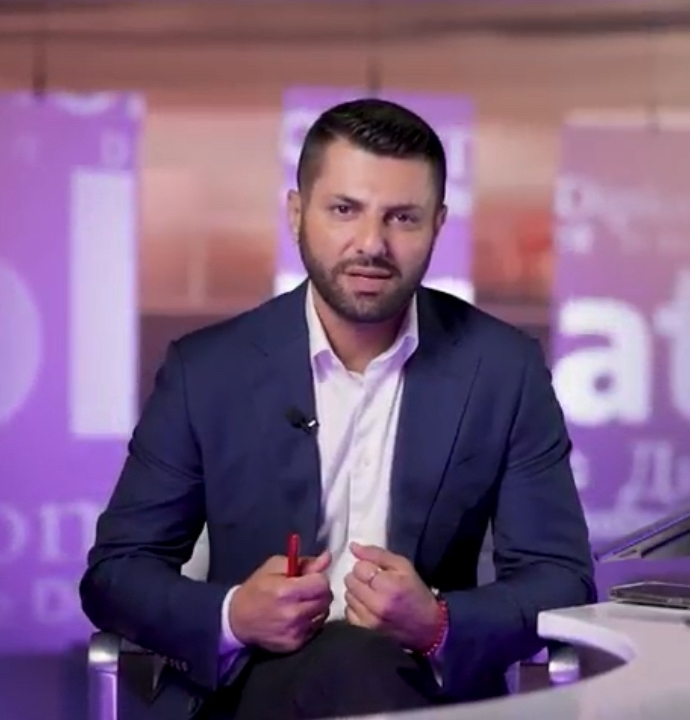
Turkey has moved so far into the center of Middle Eastern power that even its rivals can no longer plan without it. In this conversation with Soner Çağaptay, director of the Turkish Research Program at the Washington Institute for Near East Policy, for The Diplomat, he captured the shift in one line that explains almost every realignment happening today: “If you sit in Cairo, you see Turkey on every border. You cannot do Egyptian strategy without accounting for Turkey anymore.”
This is not commentary. It is a change in the map itself. And you can feel that shift in every capital from Riyadh to Jerusalem to Washington.
The moment that signaled something deeper had moved was not the Turkey-Egypt meeting. It was the scene at the airport. Sisi greeting Erdoğan at the plane door after a decade of hostility was a political tremor that said the freeze was over.
The rupture between the two countries began with the Muslim Brotherhood. Erdoğan hosted Brotherhood media in Istanbul. Egypt treated the movement as an existential threat. “Those radios went from political propaganda to nature documentaries,” said Çağaptay. “Turkey quieted them without expelling them.” The Brotherhood issue was not solved. It was put on mute.
Then came Gaza. Qatar tried to bring Hamas into negotiations and failed. Turkey succeeded. “Turkey was the missing piece,” he said. “Ankara told Hamas there was nowhere left to hide. That forced them to come to the table.”
Egypt understood exactly what that meant. Influence is still influence, even when it comes from a rival.
A Turkish Shadow Over Israel
No country feels Turkey’s rise more viscerally than Israel.
“From Israel’s perspective,” Çağaptay said, “Turkey is suddenly a northern neighbor. It controls influence in Syria and has a presence in Gaza through politics and institutions. This is new.”
Israel now places Turkey in its security debates in the same breath as threats, even when the parallel does not hold. Çağaptay was clear. “Turkey is not Iran. It recognized Israel in 1949. It does not dream of erasing it. But Israelis see Turkey everywhere now, and they react emotionally.”
Washington sees something different. Not a threat. A partner.
The Trump Triangle
Here is the part that few people grasp.
Trump trusts Erdoğan.
Trump trusts Netanyahu.
Erdoğan and Netanyahu do not trust each other.
So, Trump became the hinge between two leaders who cannot engage directly.
“He vetoed a Turkish military role in Gaza,” Çağaptay told me. “And he vetoed further Israeli strikes in Syria. He imposed a quiet detente without announcing it.”
In practice, Gaza became Israel’s protected space.
Syria became Turkey’s protected space.
And the lines held.
Why Turkey Will Not Send Troops to Gaza
Publicly, Turkey announced its intention to join a stabilization force.
Privately, no one wants that scenario.
“Washington does not support Turkish troops in Gaza,” Çağaptay said. “Israel opposes it. And Turkey knows how messy it would be.”
The risk is obvious. One accidental exchange between Israeli and Turkish soldiers would set off a regional crisis.
Turkey’s role will be humanitarian, political, and institutional. Not military. “Turkey ended one war in Syria. It did half the work to end the war in Gaza. That is the kind of role they want.”
To understand Turkish power, Gaza is not the right lens. Syria is.
“Turkey is the most important stakeholder in Syria now,” Çağaptay said.
Four million Syrian refugees live inside Turkey. They shape elections more than foreign policy does. Erdoğan cannot win without reducing that number.
“A stable Syria is not a humanitarian concern for Turkey,” Çağaptay told me. “It is electoral survival.”
Turkey has the institutions to rebuild a broken state. What it lacks is money. That is where Saudi Arabia could step in, but so far, it refuses to.
The Saudi Rivalry
Saudi Arabia offers funds, not institutions.
Turkey offers institutions, not funds.
Qatar fills the gap for Ankara.
“Think of the Middle East as three poles,” Çağaptay explained. “Iran and its clients, Israel, with the Gulf states, and Turkey with Qatar. No pole loves the other, but all need each other to balance.”
This is why Cairo, Riyadh, and Washington all find themselves coordinating with Turkey in Syria while worrying about Turkey in Gaza.
A Partner to Washington. A Threat to Israel. At Once
Turkey has achieved a rare dual position.
A partner to Washington from Africa to the Caucasus.
A threat to Israel’s security doctrine.
A necessary actor in Egypt’s strategic planning.
A competitor in Saudi Arabia’s regional ambitions.
And despite everything, it remains economically tied to Europe, militarily tied to NATO, and strategically tied to the Middle East.
Turkey does too much with too little. That is the polite way to put it. A harsher reading is that Turkey behaves like a larger power than its economy can support.
Çağaptay disagreed with the alarmist view.
“Turkey never collapses,” he said. “It gets close. It never collapses. The institutions are old and resilient. They carry the country even when politics cannot.”
The real story is how the region keeps adjusting around Turkey.
Egypt adjusts.
Israel adjusts.
Saudi Arabia adjusts.
Washington adjusts.
ــــــــــــــــــــــــــــــــــــــــ
To hear Çağaptay’s full conversation, the episode of The Diplomat is now available on YouTube, Apple Podcasts, and Spotify.

Joe Kawly
Joe Kawly is Washington Bureau Chief for MBN and a global affairs journalist with more than twenty years covering U.S. foreign policy and Middle East politics.
A CNN Journalism Fellow and Georgetown University graduate, he reports from Washington at the intersection of power and diplomacy, explaining how decisions made in the U.S. capital shape events across the Arab world.
