


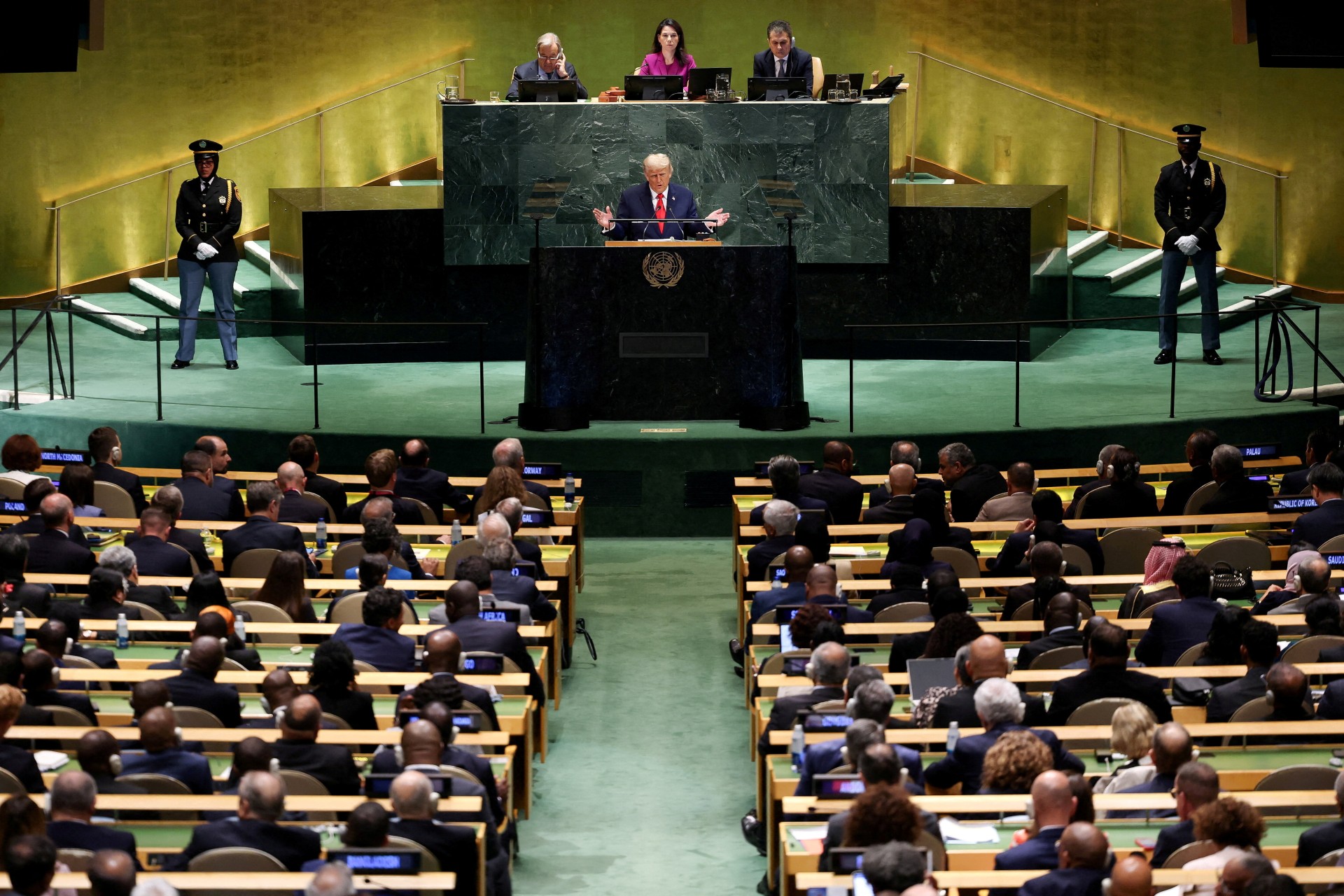
World leaders are gathering in New York this week for the 81st session of the United Nations General Assembly as a series of crises — from the U.S.-Israeli confrontation with Iran and the war in Ukraine to turmoil in global energy markets — casts a shadow over the proceedings. The Israeli-Palestinian conflict, artificial intelligence and climate change are also expected to figure prominently in the annual diplomatic gathering.
About 130 heads of state and government are expected to take part this year. The General Debate, when world leaders deliver their addresses to the assembly, begins Tuesday, Sept. 22, and runs through Sept. 28.
This year’s session is being held under the theme, “Renewing trust and managing transformation: Delivering for all.”
The meetings come as the United Nations confronts a series of wars and crises it has limited ability to influence. New York is expected to become a hub of bilateral and multilateral meetings this week, with governments seeking to chart paths through those crises outside the General Assembly chamber.
President Donald Trump is returning to the U.N. podium for the second consecutive year and is scheduled to deliver an address Tuesday, the first day of the General Debate, as the confrontation between the United States and Iran continues.
In recent weeks, Washington has scaled back the pace of major military operations and shifted toward an economic pressure campaign aimed at pushing Tehran into an agreement. Talks remain stalled, however, while disruptions to shipping through the Strait of Hormuz continue.
At the same time, recent gains by the Iran-backed Houthis, whom Washington designates as a terrorist organization, threaten shipping through the Bab el-Mandeb Strait, adding further pressure to global trade routes and energy markets.
Trump is expected to meet with Gulf leaders on the sidelines of the General Assembly to discuss next steps in the confrontation with Iran and U.S. ideas for the postwar period, according to Axios.
Iranian President Masoud Pezeshkian is scheduled to deliver his address on Wednesday. Iranian media reported that Foreign Minister Abbas Araghchi will also attend the General Assembly meetings after a brief visit to Qatar.
Israeli Prime Minister Benjamin Netanyahu is scheduled to address the General Assembly on Thursday, with several issues at the top of his government’s agenda, including the war with Iran, operations in Lebanon, the stalled peace plan for Gaza and tensions with some countries in the region.
Palestinian President Mahmoud Abbas will not travel to New York for the second consecutive year. The United States again denied him a visa, but the General Assembly voted to allow him to participate by video.
Chinese President Xi Jinping will also be absent from the New York meetings. Xi last addressed the General Assembly by video in 2021, while this year’s session coincides with expected direct talks between him and Trump in Washington.
The war in Ukraine will also feature prominently on the agenda, more than four years after the conflict began.
Ukrainian President Volodymyr Zelenskyy and Russian Foreign Minister Sergei Lavrov are both scheduled to address the General Assembly. Zelenskyy is expected to seek additional support for his country ahead of another winter, according to diplomats.
U.N. Secretary-General António Guterres has highlighted the war’s broader repercussions, particularly for food security and energy prices.
Speaking at a news conference ahead of the session, Guterres said the effective blockade in the Black Sea was compounding problems caused by the Middle East crisis. He stressed the importance of securing Ukrainian and Russian exports of food, fertilizer and energy.
Beyond the wars, artificial intelligence is emerging as one of the central issues at this year’s meetings, after a number of industry leaders called for greater controls on the development of the technology, warning of the risks of losing human control over it.
Guterres said countries leading the development of artificial intelligence should agree on “common guardrails” to avoid a race that, he said, could have serious global consequences.
Trump, in contrast, has rejected warnings about the risks posed by artificial intelligence, calling them a “hoax” and arguing that skepticism toward technological development could benefit China.
On climate, small island states and countries most vulnerable to climate change are expected to renew their calls for faster action. The world remains off track to limit global warming to 1.5 degrees Celsius above pre-industrial levels, the target established under the 2015 Paris climate agreement.