




As the world chokes under the near-total closure of the Strait of Hormuz, attention is turning to Libya as a potential savior of global energy security.
In principle, Libya’s geographic position and vast oil wealth position it well for such a role. It borders the Mediterranean and holds Africa’s largest proven oil reserves, estimated at roughly 48 billion barrels.
But the key factor here is not geography alone. There are many other factors that must be examined on the path to answering the important question: can Libya truly play the role of savior?
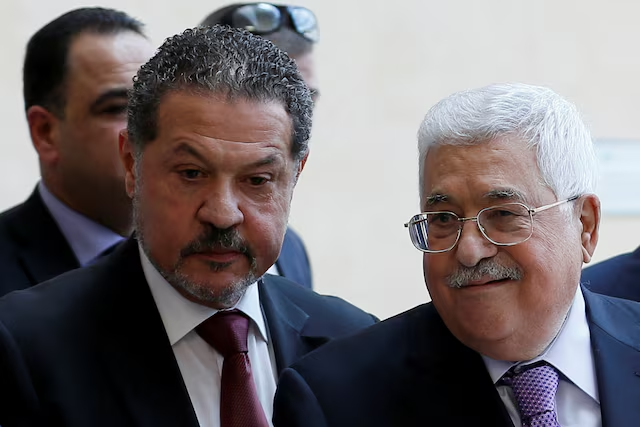
Belqasem Khalifa Haftar, head of the Libya Development and Reconstruction Fund, told Alhurra that Libya is qualified for this and capable of “rapid achievement.” He pointed in this context to the “model of the city of Derna,” which faced the disaster of Storm “Daniel” on September 11, 2023. The storm destroyed dams and caused massive damage to property, buildings, and vital facilities, before the fund and the relevant authorities managed to restore life to normal in the city within just two years.
However, on the technical level, there are factors that complicate increased oil production, which reached about 1.4 million barrels per day in April 2026.
Hafedh Al-Ghwell, Director of the North Africa Program at the Stimson Center, told Alhurra that “many wells have reached the end of their lifespan or have been neglected since the 1980s, and they need rehabilitation.”
According to Al-Ghwell, Libya “is not currently capable, and not at the required speed, of compensating for Gulf oil unless there is a fundamental shift in the flow of modern technology to revive deteriorating fields and exploit shale oil.”
The challenges are not limited to the technical aspect. There are other obstacles, including division, as well as political and security conditions, and widespread corruption in the country.
Sabina Henneberg, Senior Fellow at the Washington Institute, said that “corruption is a deeply embedded issue in Libya,” telling Alhurra that this scourge deprives the sector of the maintenance funds necessary for fields and wells.
Henneberg noted that international investors are closely watching the administrative division between Libya’s eastern and western governments, as well as the role of smuggling networks, saying: “there’s a couple things to know about smuggling, the issue of smuggling in Libya. The big thing is that whether we’re talking about smuggling of arms or fuel or humans. It is sustained by the presence of non-state armed groups in Libya, of which there are many and several are very powerful. Political actors in Libya rely on these armed groups for protection, and these groups in turn rely on smuggling for funds.”
Henneberg warned that structural issues in Libya’s energy sector continue to hinder its potential, adding that the “central bank, for example, has found that large portions of Libya’s oil revenue have typically gone unaccounted for. And this corruption, of course, denies the sector, the energy sector, needed funds for maintenance. And for other investments. And then, as you know, Libya has been identified as a potential alternative energy supplier, especially for crude oil in the case of Libya, as supplies from, the Gulf and other parts of the region are, limited due to the hostilities and the shipping constraints due to the closure of the Strait of Hormuz affect energy prices and energy supply.”
Henneberg argued that Libya’s political landscape remains deeply fractured despite shared economic incentives, saying that “I would say again that even if both governments, the side of the Government of National Unity under Abdul Hamid Dbeibeh and the side of the Government of National Stability and the House of Representatives, all controlled by the Haftar family, if they both, even though they both might have it in their interest to increase oil production and take advantage of higher oil prices, International investors, you know, I think should be looking at the persistence of these much deeper issues, again, Neither of those governments, for example, could really be considered legitimate, legitimate representatives of the Libyan people.”
On the other hand, Haftar is betting on neutralizing oil in the internal conflict and on the National Oil Corporation playing a role in the process of reunifying the country. He said that “the Corporation plays a very significant role in production and sales… and there is consensus on the security and oil situation.”
The United Nations Security Council adopted Resolution 2819, which imposes strict oversight on Libyan oil exports until August 2027 and places Libya’s wealth under international scrutiny to ensure its protection from smuggling networks and corruption.
For his part, Massad Boulos, Advisor to the U.S. President for African and Arab Affairs, held a phone call with Belqasem Haftar this April, during which they discussed ways to enhance the engagement of American companies in the Libyan market and ensure the sustainability of the unified budget to support financial stability in the country.
Haftar believes that the “path of the unified national budget,” which was approved through American mediation, represents the safest route to stability, especially in light of the current consensus among various Libyan parties on protecting the security and oil files. This paves the way for increasing production rates and securing the needs of the European market, which is eager for safe and stable energy alternatives.
Therefore, Libya appears theoretically poised to play an important role in rescuing global energy security, but the current technical and political reality imposes heavy constraints on this role.
The article is a translation of the original Arabic.


