
Dear Colleagues,
Syria is in the news. Following an August agreement, Turkey has started training Syrian forces. Russia had a large delegation led by its top energy official in Damascus last Tuesday. Saudi Arabia just announced that it will supply Syria with 1.65 million barrels of crude oil to assist the country in rebuilding its economy and infrastructure.
MBN is on the case analyzing, explaining, and contextualizing for our audiences. Keep promoting the MBN Briefing newsletter. In our latest, Randa speaks to the Abraham Accords five years on (there’s talk in Jerusalem of a security arrangement with Damascus). Our Ghassan Taqi reports on shifts in Israeli thinking on security and bridge-building with the Arab world since October 7. Rami reflects on the upcoming visit of Ahmed al-Sharaa to New York for the UN General Assembly meeting. The Syrian president, a former Al Qaeda member who fought against U.S. forces in Iraq, will fly the same skies that 9/11 terrorists crossed as they targeted the Twin Towers in 2001.
I’ve just read a new Foreign Affairs essay that argues federalism is the way to stave off a next Syrian civil war. U.S. Special Envoy Tom Barrack disagrees; Ambassador Barrack sees lethal fragmentation without a strong, centralized, unitary state. We’ll host Ayoob Kara later this month. I spoke with Ayoob last Thursday (thanks to Fadi for the introduction). Ayoob is an Israeli Druze politician, a former minister of communications who served four terms as a member of the Knesset for Likud.
The U.S. has conditioned its support for the current Syrian government on the protection of Syria’s Christians, Druze, Kurds, and Alawites.
Sectarian violence erupted in Syria this summer. In mid-July, armed groups linked to the government — mostly Sunni Bedouins — launched coordinated attacks on Druze areas of Swaida province. In just days, fighting killed hundreds of people. In a first round of violence, civilians were executed. Homes were looted and burned.
In case you missed it: The Swaida American Society, the association that represents Syrian Americans, both Druze and Christians, issued a statement last month in support of MBN. “Your commitment to truthful journalism,” the public letter reads, “and your decision to shed light on the massacres impacting our beloved community, without a political agenda or bias, have not gone unnoticed.”
The MBN Case
We’re always striving for truthful journalism. It’s a powerful weapon in America’s soft power arsenal. It’s key to our case for continued funding. I was at the White House on Friday. Last week, board chair Ryan Crocker and I were reaching out to important members of Congress, including the GOP’s Mike McCaul from Texas and Joe Wilson from South Carolina.
I was Mr. McCaul’s pick for the Senate confirmed International Broadcasting Advisory Board (IBAB). Ryan is the former House Foreign Affairs Committee chair’s man on the Afghan War Commission. Earlier this summer, Chairman Emeritus McCaul was part of a delegation to the Middle East led by Congressman Mike Lawler (R-N.Y.). The group met with heads of state, defense officials, and diplomats in Saudi Arabia, Israel, and Jordan.
Last month, Representative Wilson was in Syria as part of a bipartisan congressional delegation led by Senator Jeanne Shaheen of New Hampshire (we’re in close contact with Senator Shaheen and her staff). Mr. Wilson had been a long-time, outspoken critic of the Assad regime. Today, he shares Tom Barrack’s concerns about Syrian partition.
Let’s meet this Friday September 19 at 11:15 am for a next town hall meeting. We’ll have updates on MBN’s progress with Congress. We’ll hear from Anne on a next legal round scheduled for September 22. Meanwhile, we have editorial ideas burning holes in our pockets — and a new colleague to introduce. Friday noon lunch after the town hall. Pizza on me.
MBN’s Network
The MBN network keeps growing. I’ll see the Middle East Institute’s (MEI) Vice President Ken Pollack for coffee this month. MEI President Stu Jones was out to Springfield for a visit earlier this year. Ryan is a distinguished diplomatic fellow with Stu and Ken’s outfit; our Susan Ziadeh, member of the MBN board, is an MEI trustee as well.
On September 22, I’ll be at American University giving a talk for the Alexander Hamilton Society on democracy, human rights and national security policy. There are delicate balances and important needles to thread.
On democracy, development, and human rights in our region, we’ll host Les Campbell and Ken Wollack on October 6. Ken is a former president of the National Democratic Institute (NDI). He serves as vice chair of the National Endowment for Democracy’s (NED) board. For three decades, Les led NDI’s work on the Middle East and North Africa.
Iran, China — And A New MBN Colleague
We take a strategic view. Led by our Andres Ilves, we’ll be ramping up our coverage of Iran across our region this fall.
Last month, Iran’s Supreme National Security Council chief Ali Larijani was in Beirut, one week after the Lebanese government ordered the army to devise plans to disarm Iran-aligned Hezbollah. On Friday, the U.S. imposed sanctions on two Iran-linked Sudanese actors for fueling regional destabilization. The Department of the Treasury’s Office of Foreign Assets Control (OFAC) announced sanctions that target Finance Minister Gebreil Ibrahim Mohamed Fediel and the Al-Baraa Bin Malik Brigade (BBMB), a pro-Iranian, Islamist paramilitary organization.
Following the Israeli strike on Doha on September 9, the Iranian regime has advanced the narrative that the United States is becoming an unreliable security partner for the Gulf.
Ditto China. On September 10, Beijing’s foreign ministry suggested the Israeli strikes were tied to America’s bias towards Israel, with willful indifference to Gulf states’ security concerns. China’s CCTV keeps pushing the line that the Israeli strikes would not have been possible without American approval.
Through economic investments, diplomatic engagement, and strategic partnerships, Beijing continues to expand its influence in the region. Saudi Arabia’s crude oil supply to China is set to surge in October. A recent survey of 136 Chinese companies points to new emphasis on the Middle East. Nine out of ten respondents say they plan to expand operations in the region (the UAE has just awarded a special flight permit to a Chinese company that manufactures flying cars).
There’s opportunity, and serious responsibility in the China story for us. We’re stepping up. Starting this month, Min Mitchell joins us to lead MBN’s work tracking Chinese influence in our region. We’re contemplating a mix of interviews, videos, and newsletters. Great journalism. American interests. Integrity and credibility with MBN audiences.
We’re fortunate. Min has strong editorial and media executive experience. She is a former executive editor for Radio Free Asia and former executive director of Global News Service, a Mandarin language media outlet countering malign information promoted by the Chinese Communist Party. Min started as a television journalist in Taiwan. She brings tremendous intellectual energy and contagious enthusiasm for MBN’s next steps. You’ll meet Min at Friday’s town hall.
We’re adapting and evolving. We’re leaning into the next MBN. Thanks to you for such determination, for your deep commitment to serving the American taxpayer, and for the passion you display for our Congressionally mandated mission.
My best, Jeff

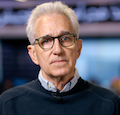
Dr. Jeffrey Gedmin
Dr. Jeffrey Gedmin is the President/CEO of MBN. Prior to joining MBN, Dr. Gedmin had an illustrious career as president/CEO of Radio Free Europe/Radio Liberty, President/CEO of the Aspen Institute in Berlin, president/CEO of the London-based Legatum Institute.
