
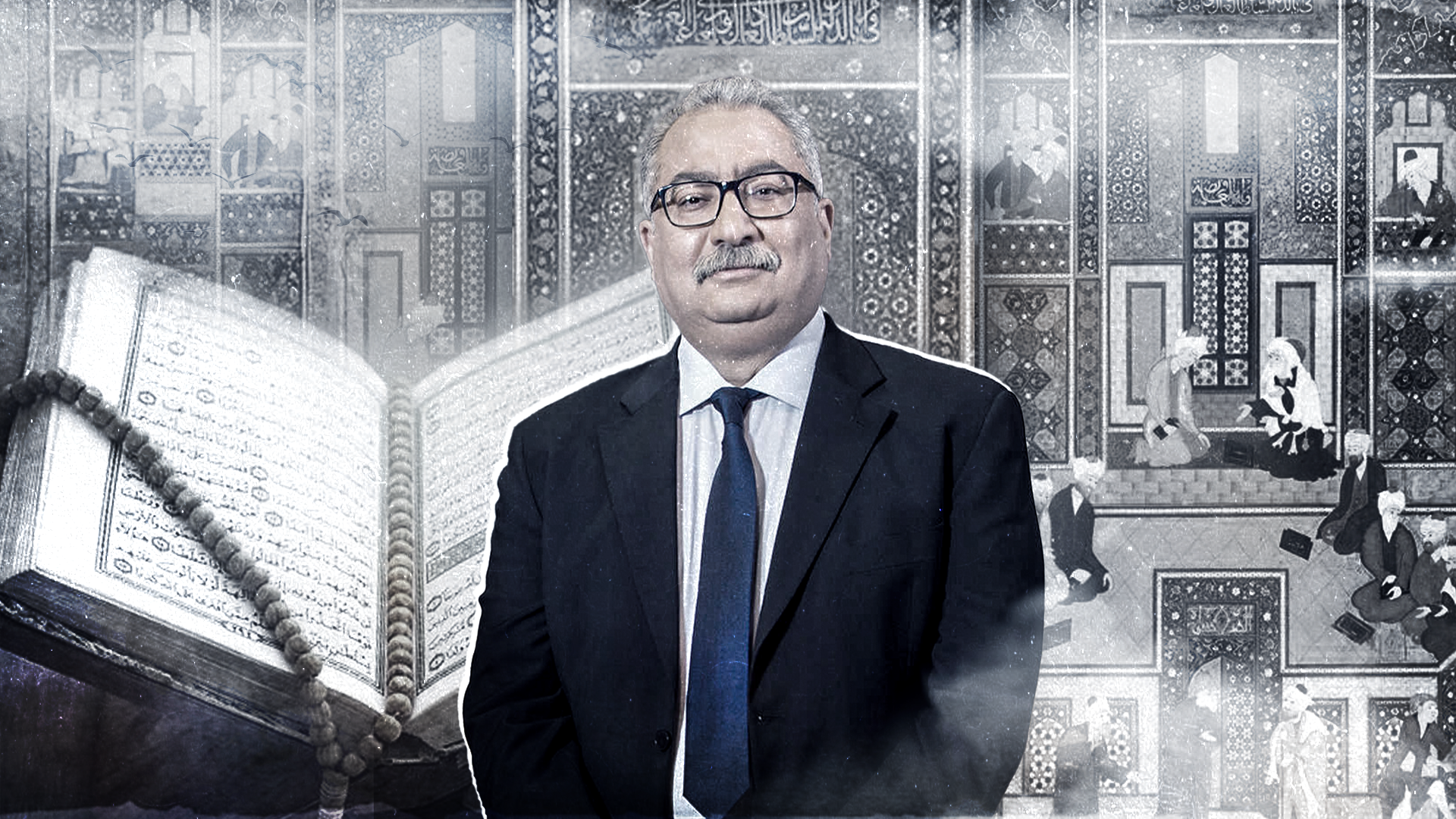

In his weekly program on Alhurra’s digital platforms, writer and journalist Ibrahim Essa examines the concept of Ahl al-Sunna wal-Jama‘a (the people of the Sunni sect who adhere to the teachings of the Prophet and his disciples). He asks what importance does the Quran hold in the dominant religious framework and why, over centuries of jurisprudence theology, the Sunna was elevated above the Quranic scripture.
Essa argues that the term of Ahl al-Sunna wal-Jama‘a itself has marginalized the Quran and that the elevation of the Sunna — especially ahad (single-chain) hadiths — has historically served political interests more than religious ones. A full jurisprudence structure, he says, was built on probabilistic reports compiled nearly two centuries after the Prophet’s death. He discusses the temporal gap between the early collection of the Quran and the much later codification of hadith, saying that reliance on single-narrator reports has created an ongoing ethical and doctrinal dilemma that still shapes religious thought. What follows is a condensed and edited version of the key points he made in the episode: Where does the Quran fit within the concept of “Ahl al-Sunna wal-Jama‘a”?
Essa says the concept prompts a persistent question: What is the Quran’s position within this framework? And why, he asks, was the Quran effectively excluded?
He notes that the term originally emerged from the faction that upheld the belief in the Quran’s uncreated nature, in opposition to the Mu‘tazilites, the early rationalist school that argued the Quran was created, and the Ash‘arites, the mainstream Sunni theologians who developed a middle-ground doctrine balancing reason and revelation. But he asks why the designation became “Ahl al-Sunna wal-Jama‘a” rather than something like “the people of the Quran, the Sunna and the community.”
He offers two explanations: The first is that belief in the Quran was so foundational that it was taken for granted and did not require explicit mention. Anyone who did not accept the Quran, he says, stood outside the religious framework altogether. The second — and in his view more likely — is that the name was meant to highlight the Sunna in contrast to the Quran. Muslims are united around the Quran, he says, while the Sunna is contested, making the term a claim of exclusive authority in that domain. But even this exclusivity is questionable, he adds, noting that Shiite traditions also have their own corpus of Sunna, narrators and legal methodology. The Sunna, he says, was never the property of a single group. Essa argues that the Sunna’s elevated status has been used to create a political and social weight inside the religious sphere — sometimes, he says, even circumventing the Quran.
A two-century gap
The central problem, Essa says, is the long-time gap between the codification of the Sunna and the much earlier collection of the Quran. Written hadith collections, including the canonical Sahih books, appeared in the third and fourth Islamic centuries. Until then, hadith circulated orally for nearly 200 years — a situation he describes as inherently troubling. By contrast, he says, the Quran was compiled almost immediately after the Prophet’s death. Muslims heard it recited directly by the Prophet in sermons, prayers and gatherings. It was memorized collectively, becoming a public and widely known text.
Hadith, he says, followed a different path. Scholars classified them into mutawatir (mass-transmitted) and ahad (single-chain) reports. Mutawatir traditions were narrated by multiple transmitters across generations, though even these do not claim absolute certainty. Ahad reports — transmitted by as few as one to three individuals — make up the bulk of the corpus and, Essa says, pose “intellectual and ethical challenges.” He questions why the Prophet would deliver rulings privately to one or two people in a community of thousands, and why a companion would then relay such statements only to one other person. Many chains of transmission, he says, rely on isolated individuals in ways he sees as inconsistent with the Prophet’s public life. Even the number of widely accepted mutawatir hadiths, he says, is disputed — with estimates ranging from 300 to as few as 30 — underscoring the limits of certainty. Despite this, classical scholars treated thousands of reports as valid sources for law, including ahad traditions. Essa argues that this reliance has had far-reaching consequences.
The political use of hadith
Essa says the decisive shift in giving the Sunna an authoritative legal role came with Imam al-Shafi‘i, who established the Sunna as the second source of legislation after the Quran. He calls this development a turning point with significant implications, arguing that the Sunna — based on human transmission — was elevated beyond what its evidentiary basis could support. He challenges the claim that hadith broadly function as an explanation of the Quran, noting that only a small fraction of hadith deal directly with Quranic interpretation. If the Sunna were truly the Quran’s primary interpreter, he says, the vast tradition of tafsir literature would be unnecessary. The Quran, he argues, was revealed to speak directly to the believer, without intermediaries. But the development of hadith science created layers of mediation — in narration, interpretation and legal derivation. He contends that some legal authorities raised the Sunna to a level that allowed certain hadith to override or contradict Quranic texts. Essa says this dynamic was exploited by political rulers, especially concerning hadith linked to violence or warfare. In his view, many of these reports — even some classified as “sound” — were invented to justify the actions of rulers who relied on force. Because the Quran could not be altered, he argues, fabricated hadith became a tool for political legitimation.
A call to return to the Quran
Essa says the backlash against those who prioritize the Quran as the primary source of religion has been severe, extending in some cases to accusations of unbelief. He notes that groups labeled “Qur’anians” — who reject hadith as a legal authority — have faced denunciation despite their stated commitment to the Quran.
He argues that questioning the role of the Sunna or proposing revisions to the major hadith collections is often treated as an attack on religion itself. He calls this reaction excessive, saying that the Quran should be recognized as the foundation of faith and that the Sunna should be open to discussion, debate and scrutiny.
Essa concludes with an appeal to “return to the Quran” as the core of religious understanding, saying that contemporary Islamic thought must confront these issues if it hopes to advance genuine reform and engage with the modern world

