
Dear Colleagues,
Iran’s deeply unpopular clerical regime apparently wants to improve the relationship between rulers and the Iranian people. Last week, the Islamic Revolutionary Guards Corps (IRGC)-affiliated Tasnim News Agency suggested that the country’s citizens be seen as strategic assets. Iranians can be doing more, the news outlet argued — in neighborhoods and through grassroots groups — to convince all of society of the responsibility to endure current hardships.
I remember an East German Communist official telling me of his frustration with apathy in the country. “Macht doch mit!” —“People, participate!” — was the regime’s clarion call, he told me. I was a Ph.D. student writing about Marxist-Leninist language theory. That was late summer 1989, a couple months before the fall of the Berlin Wall.
Iran’s economy is a mess, with stagnant growth and inflation north of 40 percent. Sanctions have limited Tehran’s access to global financial systems and have reduced oil revenues. This summer, a truckers’ strike swept through 163 Iranian cities. Drivers protested low wages, rising insurance costs, and hikes in fuel prices.
Last week, Iranian officials met in Vienna with the Europeans and the International Atomic Energy Agency (IAEA) after the E3 (the UK, France, and Germany) triggered a UN procedure to reactivate sanctions against Iran.
Iranian President Masoud Pezeshkian was shoring up support with Chinese officials and Russian President Vladimir Putin last week at the Shanghai Cooperation Organization (SCO) summit.
We’ll have more to say soon about Chinese engagement across our region. Here’s Tom Gross with our Andres Ilves on prospects for political change in Iran.
Iran, MBN Competition
The White House is weighing travel restrictions on Iran’s delegation to the UN General Assembly. Iranian diplomats could be barred from shopping at Costco, as an internal U.S. State Department memo puts it. UNGA starts in New York tomorrow and runs through the end of the month.
Abroad, Iran is implicated in terrorist attacks, most recently in Australia. At home, the regime is paving over a portion of Tehran’s largest cemetery believed to be the burial site for thousands killed in mass executions that followed the country’s 1979 Islamic Revolution. Hanging of dissidents is on the rise this summer.
We’re making the case every single day that MBN must be sustained as America’s only Arabic language media outlet on and for the Middle East and North Africa.
Competition in our region is fierce: from the Chinese and Iranians to RT Arabic, Sky, the BBC, Deutsche Welle, France24, and Al Arabiya. We’ll never have the resources of Al Jazeera with its 70 bureaus across the region and around the world.
That’s ok. In this vital soft power space, we’ll fight asymmetrically. We discussed editorial strategy and MBN’s distinctive niche at both our board meeting and a senior leadership team offsite workshop last week. We’re still at work on details and implementation plans (thanks Matt, Leila, Abed, John Dame).
There will be no surprises. You’re already on the way. We want MBN journalism that’s fresh, authentic, in the moment — dynamic, mission-aligned, and across all platforms. There’s demand. And news keeps pouring in from our region:
- On Friday, the Lebanese Council of Ministers approved a plan to disarm Hezbollah. It will be complicated. We’ll be speaking with Lebanese, Israelis, and leading American experts and officials.
- In our most recent newsletter, Randa looks at the possibility of a next Israel-Iran war.
- Colleague Dalshad Hussein reports on deep rifts in Kurdish politics that could destabilize Iraq.
- Our Ghassan Taqi says the hard push by Syria’s ethnic minorities for a federalized Syria has some observers concerned about sharp and lethal fragmentation.
- Aya has something on soft power. The animated global hit “KPop Demon Hunters” that has shattered Netflix records is taking the Middle East by storm, breaking down protectionist barriers that have prevailed for years.
President Trump says the U.S. is in “very deep negotiations” with Hamas. The UAE, signatory to the Abraham Accords, is warning Israel against annexation of the West Bank. The USS Nimitz aircraft carrier has docked at a port in Oman on the coast of the Arabian Sea. Iranian officials say their armed forces have been placed on heightened alert, suggesting new conflict with Israel.
We simply cannot afford to lose America’s voice in the Middle East.
I’ve just read Anne Applebaum in The Atlantic on American surrender in the global information wars.
We’re not done. MBN stays strategic, future first. We lean into hard change. And we know what we stand for.
It’s editorial integrity that makes for credibility and impact.
It’s passion for mission and a determined, vibrant community that drive us forward.
MBN Community
The next small staff offsite hosted by Tom Melia and me is this Thursday 11 to 1 pm in Old Town Alexandria (thanks, Lesia, for arranging and joining).
For lunch with the board, the board meeting and dinner last Thursday evening, and for Friday’s offsite with our senior leadership team — no company money or taxpayer expense involved in any of this — my thanks go to Deirdre. Deirdre managed countless details and played the indispensable coordinating role for the full slate of events. Then, too: Zadock, Mary, Ed, Manoj, Leila, Lara, Hadeel, Chams, Scott, and Lesia — thank you.
To all those who prepared food for the potluck that preceded last Thursday afternoon’s board meeting, my warmest thanks. It was a feast!
Anne, Raji, and Deirdre represented us well with strong reports to MBN trustees. We have a committed board led by Ryan Crocker.
MBN sticks together. You show grace and charm in terribly difficult circumstances. It’s a privilege, and source of inspiration for me to work with a company where everybody pitches together and everybody has everyone’s back.
My gratitude and best, Jeff

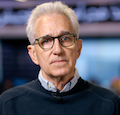
Dr. Jeffrey Gedmin
Dr. Jeffrey Gedmin is the President/CEO of MBN. Prior to joining MBN, Dr. Gedmin had an illustrious career as president/CEO of Radio Free Europe/Radio Liberty, President/CEO of the Aspen Institute in Berlin, president/CEO of the London-based Legatum Institute.
