

On the night before the trip, a short message arrived from the organizers:
“There are security procedures and some permits that have not yet been completed. We may have to wait beside the base gate, and some participants may be excluded.”
It was a stark reminder of the strict entry protocols that guard one of the most fortified military installations in the United States: the U.S. Marine Corps Base at Quantico, Virginia.
Here is the journey as I experienced it:

The Group Forms and We Set Off
We were about twenty journalists from across the world. At first light, we gathered in front of the National Press Club in Washington, the venerable building that has borne witness to countless pivotal moments in American history.
The bus pulled away, its hum soon joined by the low murmur of side conversations about the long day ahead. The date was September 11, the twenty-fourth anniversary of the attacks, and our route took us past the Pentagon itself, one of the sites struck that morning two decades ago.
It took nearly an hour to reach Quantico. The closer we drew to the base, the more the landscape changed: traffic thinned, civilian markers fell away, and military warning signs began to dominate the roadside.

The U.S. Marine Corps Base at Quantico
At the gate, two Marines boarded the bus, checked the list of passengers, and reminded us that crossing into Quantico meant stepping into a space governed entirely by military discipline.
A Military Store
Contrary to my expectations, our first stop after the security checks was not a firing range or training field, but a modest shop called Marine Mart, part of a chain of stores that supply Marines with their daily necessities. Here, we were asked if we wanted to make any purchases before heading on to the training grounds.

I bought a bottle of water, bracing for what I knew would be a long day. From there, we moved into a hall that once served as a Marine bar. Today, it bore no trace of its past, alcohol is strictly banned during training and had been repurposed as a venue for events and orientation sessions.
Waiting for us were Lieutenant Brian Hiers, a martial arts trainer, and Matt Hawkins, director of the Infantry Officers Course.
“This,” Hiers declared, “is where the United States makes its military leaders.”
Before delving into the program ahead, we paused to take in the history of the place.
Quantico Base
Quantico was established in 1917, as the United States entered World War I. What began as a modest outpost known simply as Marine Barracks Quantico grew steadily into one of the country’s most important military hubs.
Today, it is home not only to the Marine Corps’ Officers Training School and Officer Candidates School (OCS), but also to the FBI Academy and the U.S. Secret Service Training Center, institutions that give the base a role far beyond the Marines alone.

Where Every Marine Officer Begins
Our destination was TBS – The Basic School – the entry point for every Marine Corps officer. Each year, some 2,100 newly commissioned officers pass through its gates for a course that lasts about 29 weeks, or roughly six months.
Training starts with the fundamentals: individual skills and endurance. From there, it builds toward small-unit tactics at the fire team level, and ultimately culminates in complex offensive and defensive exercises designed to simulate the realities of urban combat.
Most recruits are young, between 22 and 30 years old, many of them fresh out of university. The maximum age to join is 38, though applicants over 34 need a special waiver and must clear demanding medical and physical evaluations.

The Press Conference
What sets you apart from the other U.S. armed forces?
Hawkins didn’t hesitate: “Our strategy embraces failure. The goal here isn’t to produce technical experts so much as to prepare leaders who can adapt. Our philosophy is that an officer who hasn’t tested the limits of his own failure won’t know how to lead others when they face failure.”

As the discussion shifted to values, it became clear that training at Quantico was never only physical or tactical. From the outset, each lieutenant is required to articulate his own personal values, then connect them, as Hawkins put it, to the Marine Corps’ triad: honor, courage, and commitment.
The session ended.
Outside, a press statement was recorded. Some of the foreign journalists carried a tone of discontent, a reminder of how the image of the military often shapes reporting in their home countries. What struck me most was how, whenever a question veered into ethics, another officer would redirect the exchange back to procedural details, as if wary of venturing too far into that territory.
“Time is pressing,” one female officer called out, signaling the move to our next stop.

To the “Battlefield”
We boarded the bus again. This time, papers were passed around for us to sign, essentially liability waivers. Our destination: a field designed to simulate real combat.
The ride lasted about fifteen minutes, just long enough to reveal the vastness of Quantico’s 220-square-kilometer expanse. Along the way, glimpses of the training environment came into view: concrete blocks, watchtowers, wooden barricades, fragments of a landscape built for war.

Suddenly, a small village came into view, its storefronts marked with signs in Farsi, Bank, Police, and dozens of soldiers moving through its alleys.
The moment we stepped off the bus, the quiet shattered into chaos: the crack of gunfire, clouds of white smoke, officers storming doors. Overhead, two drones circled.
Captain Oliver MacKillips, one of the supervising officers, gestured skyward. “Today you’ll see two types of drones: one for reconnaissance and surveillance, and another to simulate direct attack.”
The first was a quadcopter, hovering quietly above the rooftops, scanning for a target. The second was encased in a rubber shell, built to crash into walls without breaking. It was my first encounter with this design, known as a Collision-Tolerant Drone.
This model, MacKillips explained, is not only used in combat but also for inspecting tunnels and collapsed buildings, and even in search-and-rescue operations.

As for the officers, their six months of training unfold in relentless combat scenarios, sleeping outdoors in the rain, rotating between guard duty and snatches of broken sleep, learning to endure when exhaustion itself becomes part of the battlefield.
Back to the Bus..

The Museum
At 2 p.m., the bus set off toward the final stop of our journey: the National Museum of the Marine Corps.
Within minutes, the imposing structure came into view, its tilted metallic mast rising skyward, a design meant to echo the iconic flag-raising at Iwo Jima. That battle, fought from February 19 to March 26, 1945, saw U.S. Marines land on the Japanese island and wrest it from the Imperial Army at staggering cost.
Inside the Leatherneck Gallery, the past seemed to surround us. Overhead, aircraft hung in frozen flight: an SBD Dauntless dive bomber from World War II, and a UH-34D Seahorse helicopter poised amid the dense jungles of Vietnam.
We continued along the “Legacy Walk,” a chronological path through Marine history, from Belleau Wood in World War I, to Tarawa and Iwo Jima in World War II, to the frozen Chosin Reservoir in Korea, and finally to Desert Storm in Kuwait.

Baghdad and Saddam Hussein
At the corner dedicated to Baghdad, the walls seemed lifted straight from the streets of Iraq’s capital in the early 2000s: looming portraits of Saddam Hussein, Baath Party slogans painted bold, and the red, white, and black of Iraq’s flag under his rule.

From Baghdad, the path led to the city most inseparably linked with the Marines’ fiercest battles in Iraq: Fallujah. At its entrance, a stark warning sign greeted us: “You may encounter loud sounds, strong odors, and scenes simulating combat environments.” It was as if the museum itself was preparing us for a different kind of encounter.

The Battle of Fallujah… A Full Sensory Experience
The smell here was unlike anything else, a sharp blend of burning plastic, gunpowder, and human waste, seeping through a narrow alley built to mimic the streets of Fallujah.
Most of these scents were artificially released through hidden vents to recreate the city’s atmosphere during battle. “Some Marine veterans told us this smell alone was enough to take them right back to their service in Iraq,” explained museum director Kyle Gentry.
By 3 p.m., it was time to return. We boarded the bus once more, and with that, the journey came to an end.

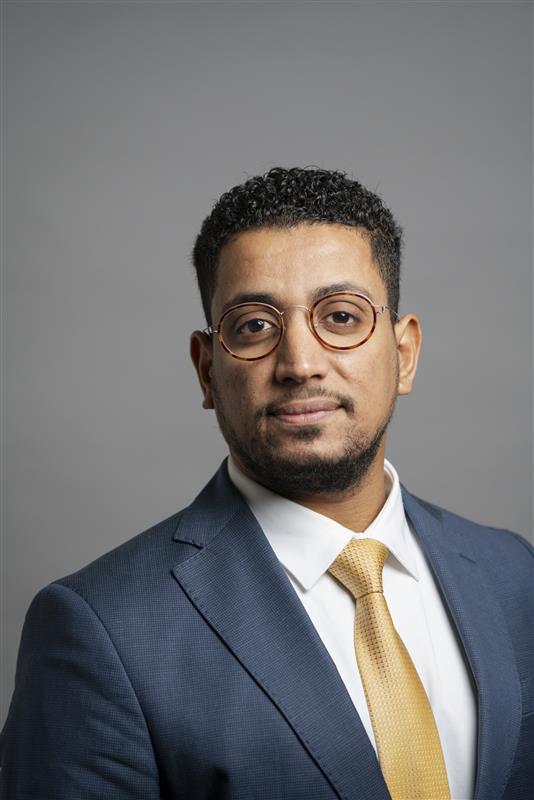
Ezat Wagdi Ba Awaidhan
Ezat Wagdi Ba Awaidhan, a Yemeni journalist and documentary filmmaker based in Washington, D.C., holds a master's degree in media studies.
